You have spent weeks planning the perfect perennial border. You picked the right plants, you amended the soil, and you placed them in what you thought was a sunny spot. Then July arrives, and the color vanishes. The leaves bleach to a pale, dusty green. The blooms shrivel before they open. You water more. You add fertilizer. Nothing brings the color back.
Most gardeners treat shade as a binary switch: you are either in the sun, or you are in the shade. This is the single most destructive misconception in garden design. It is also the reason your expensive perennials look tired by August, even when you are watering them perfectly. The truth is that most perennials do not want full sun all day. They want a specific amount of shade during the hottest part of the day, and they will tell you exactly when they are getting too much of it.
The 30% Shade Rule
There is a specific threshold of shade that changes how a plant functions. It is about the plant shutting down its own beauty to survive. I call this the 30% shade rule. It states that most flowering perennials perform best when they receive 30% shade during the peak heat hours of the day, roughly from 1 PM to 5 PM. Without that shade, the plant enters a state of chronic photoinhibition. It is working so hard to protect its own tissues from light damage that it stops producing the pigments and blooms you paid for.
Photoinhibition is not a disease. It is a physiological shutdown. When the light intensity exceeds what the plant’s chloroplasts can process, the plant literally turns off its photosynthesis to prevent cellular damage. It does this by bleaching its leaves, closing its stomata, and aborting its flower buds. The plant is not lazy. It is in survival mode. And it is doing this because you gave it too much sun.
Consider a standard hosta. Hostas are often sold as ‘shade plants.’ But a hosta placed in 100% deep shade will grow huge, dark green leaves and produce very few flowers. A hosta placed in 100% full sun will bleach to white, curl at the edges, and stop growing entirely. The hosta that produces the largest leaves AND the tallest flower spikes is the one receiving 30% shade during the afternoon. It gets enough light to fuel growth, but enough shade to prevent the photoinhibition shutdown. This is the sweet spot. This is the 30% rule.
How to Read Your Garden’s Light
You cannot guess this. You have to measure it. Most gardeners look at a spot and say, ‘It gets sun in the morning.’ That is not enough information. You need to know how much shade that spot gets between 1 PM and 5 PM. This is the critical window. If a spot receives direct sun for 8 hours, but 3 of those hours fall between 1 PM and 5 PM, it is a 30% shade spot. It is a perfect spot for most perennials.
This is too much sun for 80% of flowering perennials. The plant will survive, but it will not thrive. It will look tired. It will produce fewer blooms. The colors will fade. The leaves will scorch. This is not a watering problem. This is a light problem.
To find your 30% shade spots, you need a simple tool. You do not need a light meter. You need a piece of white paper and a pencil. Go out to your garden at 2 PM on a clear day. Hold the white paper flat on the ground where you plan to plant. Mark the shadows cast by nearby trees, fences, or buildings. Count the squares of the grid you drew on the paper that are covered by shadow. If 30% of the paper is in shadow between 1 PM and 5 PM, you have found your 30% shade spot. Plant your perennials there.
If you cannot find a 30% shade spot, you have two options. You can plant sun-loving perennials that are specifically bred to handle full exposure. You can also create artificial shade. This is where garden design becomes active, not passive. You do not just accept the light. You manipulate it.
Designing for 30% Shade
Creating 30% shade does not mean planting a giant tree that blocks all the light. It means placing plants strategically so that they shade each other at the right time. This is called interplanting. You pair a tall, late-blooming perennial with a shorter, early-blooming one. The tall plant grows enough foliage to cast a 30% shadow over the shorter plant exactly when the sun is at its peak. This is not a metaphor. This is a physical reality.
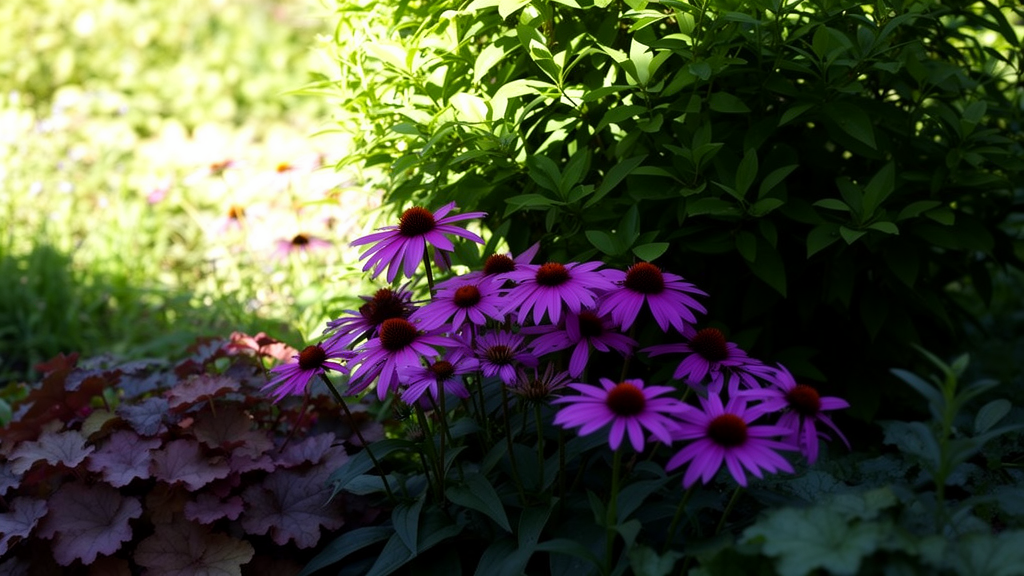
For example, plant a tall clump of *Helleborus orientalis* (Lenten rose) next to a shorter clump of *Heuchera sanguinea* (coral bells). The *Helleborus* grows quickly in spring and casts a dense shadow over the *Heuchera* during the hottest part of the day. The *Heuchera* gets enough light to bloom, but not enough to bleach. The *Helleborus* gets enough light to grow, but not enough to scorch. They are shading each other. They are surviving together. This is the 30% rule in action.
You can also use hardscape to create 30% shade. Place a low stone wall or a wooden bench on the south side of your planting bed. The wall will cast a shadow over the plants behind it between 1 PM and 5 PM. This is not an accident. This is design. You are using the geometry of your garden to control the light. You are not fighting the sun. You are working with it.
If you have no shade, you must change your plant selection. Do not try to force a shade-loving plant into full sun. It will fail. Instead, choose perennials that are adapted to full sun. These plants have thicker leaves, deeper root systems, and higher water requirements. They are not as beautiful as the plants that thrive in 30% shade, but they will survive. Examples include *Echinacea purpurea* (purple coneflower), *Rudbeckia hirta* (black-eyed Susan), and *Sedum spectabile* (stonecrop). These plants are built for the sun. They do not need shade. They do not need your pity. They need your water.
What 30% Shade Looks Like
You can see the 30% rule in action if you know what to look for. The first sign of too much sun is bleaching. The leaves turn a pale, dusty green, almost white. This is the plant’s way of reflecting excess light. It is trying to protect itself. The second sign is curling. The leaf edges curl inward, forming a tube. This is the plant closing its stomata to reduce water loss. It is trying to hold onto its moisture. The third sign is aborting blooms. The flower buds turn brown and drop off before they open. The plant is sacrificing its reproduction to save its own life.
These are not signs of disease. They are not signs of pests. They are signs of light overload. They are the plant’s way of saying, ‘I am working too hard. I need shade.’ If you see these signs, do not water more. Do not fertilize more. Do not spray for bugs. Give the plant 30% shade. You can do this by planting a taller plant next to it, by placing a shade cloth over it, or by moving it to a shadier spot. The plant will recover. It will start producing color again. It will start blooming again. It will start growing again.
The Honest Limits of 30% Shade
The 30% shade rule is not a magic bullet. It does not apply to every plant. It does not apply to every climate. It does not apply to every soil type. It is a guideline. It is a starting point. It is a way to think about light, not a rule to follow blindly.
In hot climates, 30% shade is not enough. In Arizona, for example, 30% shade might still be too much sun for many perennials. You might need 50% shade. In cool climates, 30% shade might be too much. You might need 10% shade. The 30% rule is a baseline. It is a place to start. It is not a place to stop.
Furthermore, the 30% rule assumes that you are watering correctly. If you are underwatering, 30% shade will not save you. The 30% rule is a light rule. It is a light rule. If you ignore the water rule, the 30% rule will not work. The 30% rule is one part of a larger system. It is not the whole system.
Why This Matters
The 30% shade rule matters because it changes how you see your garden. It changes how you see light. It changes how you see plants. It is about growing better. It is about planting smarter. It is about working with it.
When you understand the 30% shade rule, you stop blaming your plants for failing. You stop blaming your water. You stop blaming your soil. You start blaming the light. And once you blame the light, you can fix it. You can create shade. You can manipulate light. You can design for 30% shade. You can grow perennials that thrive, not just survive. You can grow perennials that bloom, not just grow. You can grow perennials that are beautiful, not just alive.
This is the 30% shade rule. It is a fact. It is a fact that you can see, measure, and use. It is a fact that will change your garden. It is a fact that will change your life. It is a fact that will change everything.