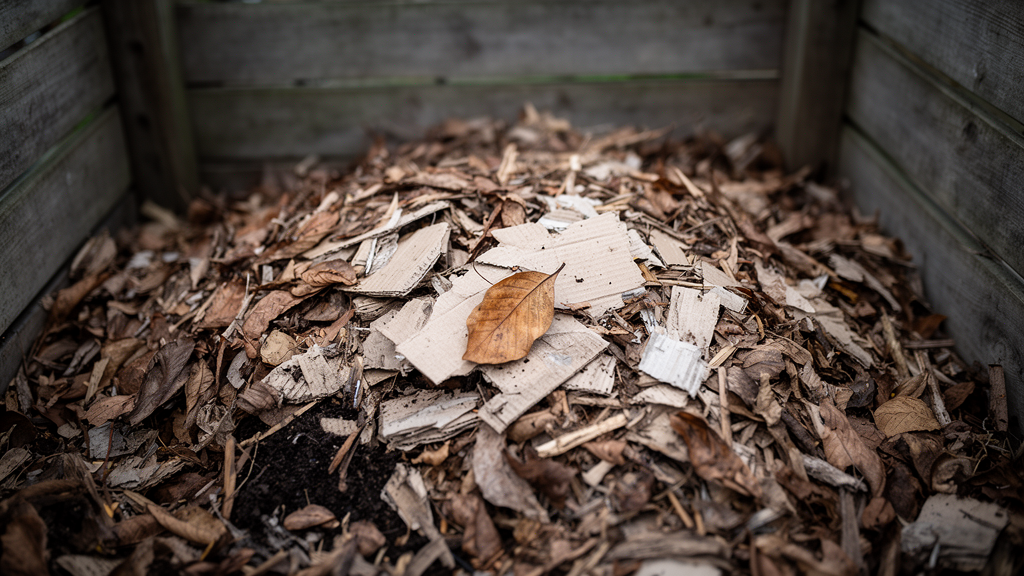
You open the bin, expecting the sour, acidic stench of a failed pile. Instead, you smell nothing. Not even a hint of decay. It smells like an empty room. This silence is not a sign of success. It is the sound of carbon burning through its last reserves, leaving the pile structurally hollow and biologically exhausted.
Your compost is not smelly. It is starving. The lack of odor means your carbon-to-nitrogen ratio has swung so far toward browns that the microbial population has collapsed from lack of fuel. You have built a pile of dry leaves and cardboard that will take eighteen months to break down, if it breaks down at all. The fix is not more air. The fix is nitrogen.
The Nitrogen Starvation Trap
Most gardeners approach composting as a balancing act between “greens” (kitchen scraps, grass clippings) and “browns” (leaves, twigs, paper). This framing is technically correct but practically useless because it ignores the actual mechanism of decomposition. Composting is not a balance. It is a fuel mixture. And your pile is running on empty.
Microbes are the engines of decomposition. They consume carbon for energy and nitrogen to build the proteins required to reproduce. When you add too many browns, you give the microbes a massive energy surplus but starve them of the building blocks they need to multiply. The result is a dormant pile. The microbes enter a state of suspended animation, waiting for a food source that never arrives.
Smell is the byproduct of failure, not success. A foul, ammonia-heavy odor means you have too much nitrogen and the microbes are excreting it as gas. A sour, vinegar-like smell means the pile is anaerobic, lacking oxygen. But a complete lack of smell? That means the microbes are simply gone. They have died off, or gone dormant, because the carbon source is too tough and the nitrogen source is non-existent.
The 30:1 Ratio Is a Myth
You have likely been told to aim for a 30:1 carbon-to-nitrogen ratio by volume. This is the single most dangerous piece of advice in home composting. By volume, a pile of dry leaves is mostly air. If you mix leaves and kitchen scraps by volume, you are mixing mostly air with mostly water. The microbes cannot access the carbon in the leaves because the surface area is too small, and they cannot access the nitrogen because there is none.
Real composting requires a ratio by weight, not volume. And it requires a specific type of nitrogen. Dry leaves contain carbon, but they contain almost zero nitrogen. Grass clippings contain nitrogen, but they contain very little carbon. If you layer them, you create distinct zones. The leaves sit untouched. The grass clippings rot into a slimy, anaerobic mat. The microbes in the middle starve.
The solution is to stop layering. Layering is a technique for people who want to hide their kitchen scraps. It is a failure of integration. You must mix your materials until they are indistinguishable. A properly mixed pile looks like a dark, crumbly soil. It does not look like a salad. It looks like a smoothie. The carbon and nitrogen must be intimately mixed at the microscopic level so the microbes can access both simultaneously.
The Kitchen Scrap Deficit
Most home composters do not have enough kitchen scraps. A standard family generates about one pound of kitchen scraps per day. To compost that effectively, you need roughly three pounds of dry leaves or shredded cardboard. That is a three-to-one ratio by weight. If you are adding five pounds of leaves for every pound of scraps, you are not composting. You are slowly burying your scraps in a dry grave.
The fix is to supplement your carbon source with a high-nitrogen material. Coffee grounds are the easiest. They are nitrogen-rich, acidic, and readily available. But you do not need coffee grounds. You can use blood meal, feather meal, or even a handful of fresh garden weeds before they go to seed. The goal is to spike the nitrogen content of the pile so the microbes wake up and start eating.
If you have a pile that has been sitting for months with no change, do not turn it. Turning a dormant pile just exposes it to more air and slows it down further. Add nitrogen. Mix it in. Wait. The microbes will wake up within a week. You will feel heat. You will see steam. You will know the pile is alive again.
The Moisture Trap
Starvation often masquerades as dryness. A starving pile is a dry pile. The microbes need water to transport nutrients. If the pile is dry, they cannot function. But adding water to a dry, carbon-heavy pile does not fix the problem. It just makes wet cardboard. You must add nitrogen first. Nitrogen creates the biomass that holds water. Carbon holds the structure. Without nitrogen, the structure collapses.
The test is simple. Take a handful of compost from the center of the pile. Squeeze it. If water drips out, it is too wet. If it falls apart, it is too dry. If it holds its shape but feels dry to the touch, it is starving. Add nitrogen. Mix. Wait. The pile will heat up. The pile will shrink. The pile will become soil.
What to Do When Your Pile Is Silent
If your compost bin is silent, stop adding browns. Stop adding leaves. Stop adding cardboard. Add nitrogen. Add kitchen scraps. Add grass clippings. Add coffee grounds. Add a handful of garden soil to introduce a fresh population of microbes. Mix it all together. Wait. The silence will break. The heat will return. The pile will work.
Composting is not a set-and-forget task. It is a living system. It requires feeding. If you stop feeding it, it stops working. Your compost is not smelly. It is starving. Feed it. Then watch it work.