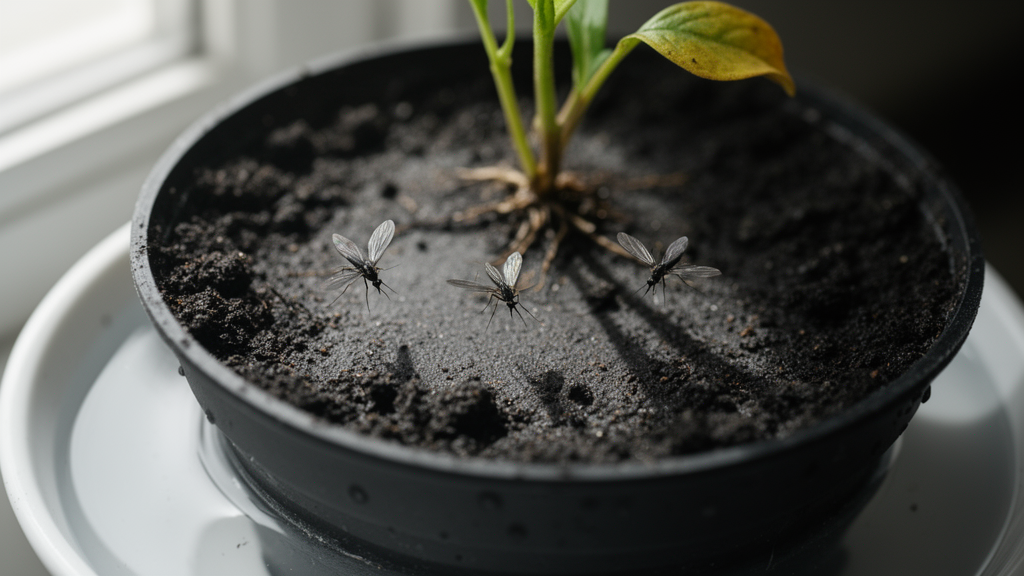
You’ve sprayed for fungus gnats three times this month. The adult flies keep returning, the soil stays dark, and your seedlings are stalling. The gnats are not the pest. They are the symptom. The real problem is a soil fungus feeding on your roots, and treating the flies without fixing the soil biology is like chasing the smoke alarm instead of the fire.
Fungus gnats (Bradysia spp.) are the most misunderstood pest in container gardening. Every gardener has seen them: tiny, dark, mosquito-like flies hovering over the soil surface. They are annoying, they look like they carry disease, and they trigger the same panic response as spider mites or aphids. Most gardeners reach for a second application of insecticidal soap, a sticky trap, or a drench of spinosad, and wonder why the flies come back next week.
Here is the part nobody tells you: adult fungus gnats do not eat your plant. They cannot. Their mouthparts are vestigial. They exist to lay eggs in the top two inches of moist soil. The larvae, which look like translucent worms with shiny black heads, are the only stage that feeds. And they do not eat healthy roots. They eat decaying organic matter, fungal hyphae, and root tips that are already damaged by overwatering, compaction, or salt buildup.
When you see fungus gnats, you are looking at a soil biology problem, not an insect problem. The flies are the smoke alarm. The fungus is the fire. Fix the soil, and the flies disappear within two weeks. Spray the flies, and they return as soon as the soil stays damp.
Why Your Soil Feeds the Fungus
Fungus gnats thrive in a very specific soil environment. They need moisture, organic matter, and low oxygen levels at the root zone. Every container that stays wet for more than 48 hours creates that environment. Bagged potting mixes are the worst offenders. They contain peat moss, which holds water like a sponge, and fine bark, which breaks down into a dense mat that suffocates roots. When you water such a mix, the top two inches stay wet for days. The oxygen content drops below 5 percent. That is the exact threshold where aerobic soil biology collapses and anaerobic fungi take over.
The fungus gnats love this fungus. The larvae feed on the fungal hyphae, which grow in the waterlogged soil. The more fungus, the more larvae. The more larvae, the more eggs. The more eggs, the more adults. It is a closed loop, and the flies are just the visible end of a chain that started with your watering habit.
Root damage follows. Larvae chew through root tips, which are the plant’s only mechanism for taking up water and nutrients. When root tips are destroyed, the plant cannot absorb water even though the soil is wet. The plant wilts. The gardener waters more. The soil stays wet. The fungus grows. The gnats multiply. The plant dies.
This cycle kills more container plants than any pathogen. It is not a disease. It is a soil-chemistry failure. The fix is not chemical. It is physical.
The Two-Week Dry-Out Rule
The single most effective treatment for fungus gnats is not a spray, a drench, or a biological agent. It is water management. You must dry the top two inches of soil between waterings. This is the Two-Week Dry-Out Rule, and it works because it breaks the egg-laying cycle.
Fungus gnat eggs require moisture to hatch. They die in soil that stays dry for more than 48 hours. Larvae cannot survive without constant moisture. If you let the top two inches dry out completely, the eggs desiccate, the larvae starve, and the next generation never hatches. Within two weeks, the adult population collapses because there is no food source left for the next brood.
How do you know when the top two inches are dry? Stick your finger into the soil up to the second knuckle. If it comes out clean and dry, the soil is ready to water. If it comes out dark and damp, wait another day. If you are growing in a container with no drainage, stop. You are creating the exact conditions that guarantee gnats. Every container must have drainage holes, and every container must sit on a saucer that you empty within 24 hours.
This rule applies to every container plant, regardless of species. Herbs, vegetables, houseplants, seedlings. If the soil stays wet for more than 48 hours, you are feeding the fungus. If you are feeding the fungus, you are feeding the gnats. The flies are not the problem. The wet soil is.
Why Biological Controls Fail
You have probably read advice to introduce Bacillus thuringiensis israelensis (Bti) or nematodes (Steinernema feltiae) to kill the larvae. These biological controls exist, and they work. They also fail most of the time, and here is why.
Bti releases toxins that kill gnat larvae when they ingest it. It works in standing water, in mosquito dunks, and in soil that stays consistently moist. If you let the soil dry out, the Bti degrades within 48 hours. You have to reapply it every time you water, which means you have to water frequently, which means the soil stays wet, which means the fungus grows, which means the gnats return. The biological control is a bandage on a wound that never heals because you keep watering the same way.
Nematodes work similarly. They hunt larvae in the soil. They require moisture to move. They die in dry soil. If you do not water frequently enough to keep them alive, they die. If you water frequently enough to keep them alive, the fungus thrives, and the gnats return. You are paying for a product that requires you to maintain the exact conditions that created the problem in the first place.
This is not to say biological controls are useless. They are useful when you need to break an active infestation while you fix the soil. Use Bti or nematodes once, let the soil dry out, and do not water until the top two inches are dry. The biological control does the heavy lifting for one cycle. The dry-out rule does the heavy lifting for every cycle after that.
What Your Soil Mix Actually Contains
Most bagged potting mixes contain peat moss, vermiculite, perlite, and fine bark. Peat moss holds water. Vermiculite holds water. Fine bark breaks down into a dense mat that holds water. The result is a soil mix that stays wet for 5 to 7 days in a standard 6-inch container. That is 5 to 7 days of anaerobic conditions. That is 5 to 7 days of fungal growth. That is 5 to 7 days of gnat eggs hatching.
When you buy a bagged mix, read the label. If it says “peat-based” or “contains peat moss,” you are buying a water-holding sponge. If it says “contains fine bark” or “contains composted bark fines,” you are buying a soil that will compact and suffocate roots within three months. Neither is wrong for every plant. Both are wrong for seedlings, herbs, and vegetables grown in containers.
The fix is to amend the mix. Add coarse perlite at a 1:1 ratio by volume. Add aged pine bark fines at a 1:4 ratio by volume. Add worm castings at a 1:10 ratio by volume. This creates a soil that drains within 24 hours, holds enough moisture for root uptake, and stays oxygenated enough to support aerobic biology. The fungus cannot grow in oxygenated soil. The gnats cannot lay eggs in dry soil. The plant thrives in well-drained soil.
This is the exact ratio that works for every container plant. It is not a recommendation. It is a soil-chemistry fact. If your soil stays wet for more than 48 hours, you are growing fungus. If you are growing fungus, you are growing gnats. The flies are not the problem. The soil is.
When the Flies Are Already There
Sometimes the flies are already there. You have seen them. You have trapped them. You have sprayed them. The infestation is active. In this case, you need to break the cycle immediately while you fix the soil. Here is the exact protocol.
Step one: remove the top two inches of soil. This contains 80 percent of the eggs and larvae. Replace it with fresh, dry potting mix. This removes the immediate food source and egg load. Step two: apply a single drench of Bti or nematodes to the remaining soil. This kills the larvae that are already present. Step three: let the soil dry out completely. Do not water until the top two inches are dry. This breaks the egg-laying cycle. Step four: replace the top two inches of soil with fresh mix every time you water. This prevents the gnats from re-establishing. Step five: repeat until no flies appear for 14 consecutive days. This confirms the cycle is broken.
This protocol works because it attacks the problem at every stage. It removes the eggs, kills the larvae, breaks the egg-laying cycle, and prevents re-establishment. It does not rely on chemical sprays. It relies on soil biology. The flies are not the problem. The soil is.
The Honest Limits
This advice does not work for every plant. Some plants require consistently moist soil. Ferns, calatheas, and some tropical houseplants will wilt if the soil dries out completely. If you grow these plants, you cannot use the Two-Week Dry-Out Rule. You must use a different strategy: bottom-watering, which keeps the soil moist without wetting the surface, or a soil mix with higher perlite content, which drains faster while holding enough moisture for root uptake.
This advice also does not work if your soil contains rotting organic matter. If you have buried fruit peels, coffee grounds, or decaying plant material in your container, the gnats will return regardless of how dry the soil gets. They feed on decaying matter. Remove the decaying matter, and the gnats lose their food source. The flies are not the problem. The decaying matter is.
Finally, this advice does not work if your drainage is blocked. If your container has no drainage holes, or if the drainage holes are clogged with soil, the soil will stay wet indefinitely. The gnats will return indefinitely. Fix the drainage, and the gnats disappear. The flies are not the problem. The drainage is.
What This Changes About How You Grow
Fungus gnats are not a pest. They are a soil-chemistry signal. When you see them, you are looking at a soil that is too wet, too dense, or too rich in decaying organic matter. The flies are not the problem. The soil is.
When you understand this, you stop spraying. You stop buying biological controls. You stop wasting money on sticky traps. You start looking at your soil. You start checking drainage. You start adjusting your watering. You start amending your mix. The flies disappear within two weeks. The plant thrives. The soil biology recovers. The garden becomes easier to grow because you are growing soil, not fighting insects.
This is the part that changes everything. Fungus gnats are not the problem. They are the symptom. Fix the soil, and the flies disappear. The Whitefly Egg Clue: Why Your Plants Keep Dying After You Spray The flies are not the problem. The soil is.