
You spray the whiteflies. You wait a week. The plant looks fine. Then it drops three leaves, then five, then the whole stem goes limp. You spray again. The cycle repeats until the plant is dead, and you are left wondering what you did wrong. The answer is not that your spray was weak. It is that you missed the eggs.
Whitefly eggs are not the problem you think they are. They are the reason your integrated pest management plan fails every single time you rely on a single spray cycle. Most gardeners treat whitefly infestations like a surface-level cleaning job, spray the adults, watch them fall, move on. The adults are the visible part of the infestation, but they are not the population. The eggs are. And they are hiding in places your spray never reaches.
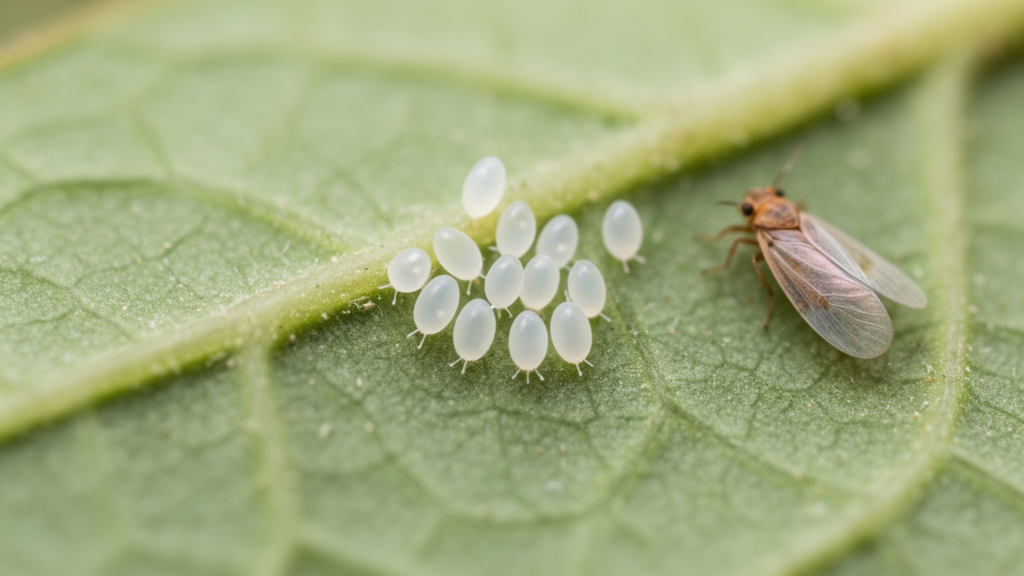
A whitefly egg is roughly 0.2 millimeters long. It is oval, slightly flattened on one side, and attached to the leaf surface by a microscopic stalk. It looks like a tiny, translucent teardrop. You can barely see it without a hand lens. More importantly, it is waterproof. The spray you just bought, the neem oil you mixed, the insecticidal soap you applied, none of it penetrates the eggshell. The chemical sits on the leaf, evaporates, and does exactly nothing to the 200 eggs you just ignored.
Here is what happens next. The eggs hatch in five to fourteen days, depending on the species and the temperature. You have just hatched a new generation of adults inside your plant canopy. They mate. They lay another batch of eggs. You spray again. You miss the eggs again. The population doubles, then quadruples, then explodes. The plant cannot photosynthesize fast enough to replace the sap being pulled by thousands of feeding nymphs. The stems collapse. The leaves yellow. The plant dies. And you blame yourself for not spraying hard enough.
The real problem is not the spray. It is the timing. You are spraying at the wrong moment, against the wrong life stage, with the wrong chemistry. Whiteflies are not a single pest. They are a group of species, and the most common ones on home plants are the greenhouse whitefly (Trialeurodes vaporariorum) and the silverleaf whitefly (Bemisia tabaci). Both look nearly identical to the naked eye. Both lay eggs on the undersides of leaves. Both produce the same waterproof eggshell. But they have different temperature tolerances, different lifespans, and different vulnerabilities. Treating them as one thing is why your treatment fails.
Greenhouse whitefly eggs hatch in five to seven days at 70°F. Silverleaf whitefly eggs take seven to ten days at the same temperature. That three-day difference matters. It means your spray cycle has to account for the exact species you are fighting. If you spray every seven days, you will kill the first generation of adults, but you will miss the second generation of eggs that hatched three days later. If you spray every ten days, you will kill the second generation, but the first generation’s eggs will have already hatched and laid their own eggs by the time your spray hits. You are always one generation behind.
So how do you catch them? You stop spraying adults. You start counting eggs.
Get a hand lens. A 10x magnification lens is fine. A jeweler’s loupe works. Look at the undersides of the leaves. Look for the tiny, translucent teardrops. Count them. If you see more than ten eggs per square inch of leaf surface, you have an active infestation. If you see fifty, you have a crisis. If you see hundreds, the plant may already be beyond saving. But here is the key: you now know exactly how many days until the next generation of adults emerges. You can time your intervention perfectly.
Timing is everything. The window between egg hatch and adult emergence is seven to fourteen days. During that window, the whitefly is a nymph. It looks like a tiny, flat, translucent scale attached to the leaf. It does not fly. It does not jump. It feeds. It is vulnerable. This is when you spray. This is when your insecticidal soap or neem oil actually works, because the nymph’s outer layer is soft and permeable. The chemical enters the body. The nymph dies. The next generation never forms.
But you cannot spray every day. You cannot spray every three days. You will burn the leaves. You will stress the plant. You will make the problem worse. So you spray once, when the eggs are about to hatch. You wait. You watch. You count. When the next batch of eggs appears, you spray again. You repeat this cycle until you see zero eggs for three consecutive weeks. That is when you stop. That is when the infestation is truly broken.
Most gardeners give up at step two. They spray once. They see adults return. They spray again. They see adults return. They spray a third time. They give up. They throw the plant out the window. They buy a new one. They repeat the cycle. This is not a failure of chemistry. It is a failure of observation. You are treating the symptom, not the source. The source is the eggs. The eggs are invisible. The eggs are waterproof. The eggs are the reason you are losing plants.
There is one more thing you need to know. Whiteflies do not just live on your plants. They live in the soil. They live in the mulch. They live in the debris under your pots. They live in the cracks of your greenhouse bench. They live in the weeds growing between your patio stones. You can spray your plant every day for a month, and if you do not address the surrounding environment, the whiteflies will return. They always return.
So clean the area. Remove the debris. Sweep the floor. Wipe the bench. Throw away the dead leaves. Replace the mulch. Spray the surrounding plants. Spray the weeds. Spray the cracks. Spray the soil surface. Spray everything. Then wait. Then count. Then spray again. Then wait. Then count. Then spray again. Then wait. Then count. Then stop. Then breathe.
This is not a quick fix. This is a three-week commitment. It is a weekly chore. It is a habit. It is the difference between losing a plant and keeping a plant. It is the difference between spraying forever and spraying once. It is the difference between fighting a pest and understanding a lifecycle.
Whiteflies are not your enemy. They are a biological process. They are a cycle. They are a rhythm. You do not fight a rhythm. You step out of it. You count the eggs. You time the spray. You clean the environment. You wait. You count. You spray. You wait. You count. You stop. You breathe. You grow.