More than half the tubers you harvest from a sweet potato vine come from the nodes you pin into the soil, not the soil you put in the pot. The plant does not care about your trellis. It grows tubers only when the stem is forced downward, and your horizontal support is starving you of harvest.
Most container gardeners treat sweet potatoes like any other vine crop. They plant the slip, build a support structure, and let the stems sprawl outward in every direction, hoping that more leaves equal more food. The result is a lush, leafy jungle that produces exactly one small tuber, or none at all. The plant is not broken. It is simply following its own evolutionary logic, which prioritizes climbing over storage when given the chance to reach the sky.
Sweet potatoes (Ipomoea batatas) are not potatoes. They are not even in the same botanical family. Potatoes are nightshades that grow from tubers, which are swollen underground stems. Sweet potatoes are morning glories that grow from tuberous roots, which are swollen underground roots. This single anatomical difference dictates everything about how you must grow them in a container. When you understand that the plant is trying to become a climbing vine, you stop fighting its nature and start directing it toward the harvest.
The secret to a heavy harvest in a container is not more soil. It is gravity. Specifically, it is the physical act of bending the growing stem and pinning it into the soil. A sweet potato vine will not form a tuber on a vertical stem. It will not form a tuber on a stem that is pointing toward the sun. It forms a tuber only when a node is pressed into the growing medium, triggering a localized hormonal response that forces that specific point to swell into a storage organ.
This is not a theory. It is plant physiology. When a node is buried, the plant detects the lack of light and the presence of soil, and it shifts resources from vertical elongation to horizontal storage. The node swells, forming a tuberous root. If you leave the stem hanging in the air, the plant assumes it is still climbing and pours all its energy into producing leaves and extending the vine. You end up with a massive, beautiful plant and an empty pot.
The Anatomy of a Tuberous Root
To grow sweet potatoes successfully, you must first unlearn the potato logic. A standard potato grows from a seed potato, which is a piece of a previous year’s tuber. A sweet potato grows from a slip, which is a rooted cutting pulled from a mature tuber. The slip is the starting point. The mature plant is the machine that converts sunlight into starch.
Because sweet potatoes are tuberous roots, they are incredibly sensitive to soil compaction and poor drainage. In a container, this sensitivity is magnified. If the soil is too dense, the developing tuber cannot expand. If the soil stays wet, the tuber rots. If the soil is too shallow, the tuber stays small. You need a container that is both deep and wide. A standard 5-gallon bucket is too shallow. A 10-gallon fabric pot is the minimum. A 15-gallon half-barrel is ideal. The wider the pot, the more nodes you can pin into the soil, and the more tubers you will get.
The soil mix is equally critical. You cannot use standard bagged potting mix. It holds too much water and breaks down too fast, suffocating the roots. You need a gritty, fast-draining mix. A 3:1:1 ratio of peat moss or coco coir to perlite to compost works perfectly. This mix provides enough structure for the roots to push through, enough air for the roots to breathe, and enough nutrients to fuel the initial growth. Add a handful of bone meal at planting time to give the developing tubers a phosphorus boost. Phosphorus is the primary nutrient for root development.
The Pinning Technique
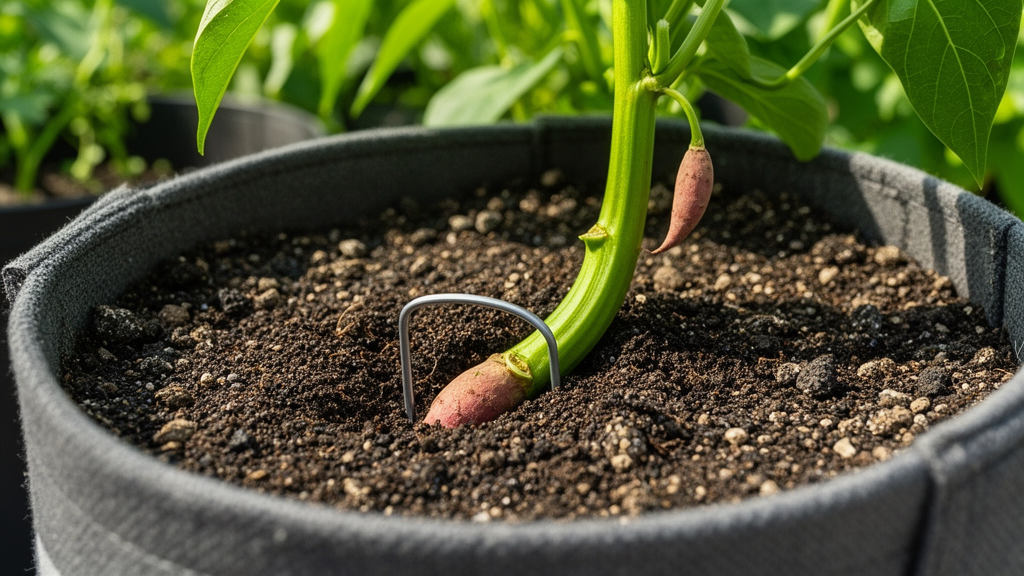
Here is the actual method that produces tubers. It is called pinning, and it is the single most important skill for container sweet potato growers. Once your slip has established itself and the main stem has grown about 12 to 18 inches, you stop letting it grow upward. You take the stem, bend it down until a node touches the soil surface, and you pin it down with a U-shaped piece of wire, a rock, or a heavy staple. You cover the node with an inch of soil. You leave the rest of the stem hanging in the air.
Repeat this process every 6 to 8 inches of stem growth. Bend, pin, cover. Leave the tip of the vine growing upward to keep the plant alive and photosynthesizing. By the time the vine reaches the top of your trellis, you will have pinned 4 to 6 nodes into the soil. Each pinned node has the potential to become a large, market-sized tuber. The hanging tip continues to produce leaves, which feed the entire system.
This technique works because it forces the plant to store energy. The plant is trying to climb. You are forcing it to stop climbing and start storing. The result is a massive, starchy reward. If you skip pinning, you get a vine. If you pin, you get food.
Light, Water, and the Final Push
Sweet potatoes are heat lovers. They need full sun, at least 8 hours of direct light per day. In a container, the soil heats up faster than in the ground, which is both a blessing and a curse. It speeds up growth, but it also increases the risk of drying out. Water deeply and consistently. The soil should be moist, not soggy. If the soil dries out completely, the developing tubers will crack. If it stays wet, they will rot. Check the soil daily in the peak of summer.
As the season ends, the plant will signal that it is done. The leaves will turn yellow and die back. This is the signal to stop watering. Let the soil dry out completely for two weeks before harvest. This allows the tubers to cure in the ground, thickening their skins and improving their storage life. When you finally lift the soil, you will find not one, but a cluster of large, starchy tubers. You will have grown a full harvest in a single container.
This method is not just for sweet potatoes. It works for any plant that grows from tuberous roots. You can use the same pinning technique to grow dahlias, though they are true tubers and require different soil conditions. You can use it to grow sweet potatoes in the ground, though you will need a much larger area to pin the vines. The principle remains the same: gravity is your primary tool for directing plant energy.
When Pinning Fails
There are times when pinning will not work. If you plant the slip too deep, the stem will rot before it can establish. If you use a pot that is too small, the tubers will have nowhere to expand. If you plant the slip too late in the season, the plant will not have enough time to form large tubers before the first frost. Sweet potatoes need 100 to 120 days of warm weather to produce a full harvest. In cooler climates, you must start the slips indoors in late winter and transplant them outside after the last frost.
Another common failure point is using the wrong variety. Some sweet potatoes are grown specifically for ornamental foliage. They are bred to produce colorful leaves, not large tubers. If you buy a ‘Margarita’ or ‘Blackie’ sweet potato from a garden center, you are buying a decorative plant, not a food crop. You must buy a culinary variety, such as ‘Burgundy’, ‘Beauregard’, or ‘Centennial’. These are bred to produce large, starchy tubers. The difference is genetic, and it is the difference between a harvest and a houseplant.
Finally, do not confuse sweet potatoes with yams. True yams are a different plant entirely, native to Africa and Asia. They are much larger, much drier, and much harder to grow in a container. If you want a fast, reliable harvest in a pot, stick to sweet potatoes. They are forgiving, productive, and incredibly rewarding. They are also one of the most efficient calorie-producing plants on earth. A single 15-gallon container can produce 10 to 15 pounds of tubers. That is enough to feed a family for months.
The next time you plant a sweet potato, stop thinking about it as a vine. Start thinking about it as a storage engine. Give it a big pot, a gritty mix, full sun, and the freedom to pin its own stems into the soil. You will be surprised at how much food a single plant can produce when you stop fighting its nature and start directing it. The plant is not growing backwards. It is growing exactly where you tell it to. The question is, are you telling it to grow up, or are you telling it to grow down?
Sources & Further Reading
- Growing Sweet Potatoes in the Home Garden — University of Maryland Extension
- Sweet Potato Production — Ohio State University Extension
- Sweet Potatoes: A Guide to Growing and Cooking — United States Department of Agriculture