You reach down to pull a wilting cucumber vine, expecting to find the culprit. The stem is blackened at the base, the leaves are curling into tight, brittle spirals, and the plant has surrendered in a single afternoon. Your gut says squash bug because the damage looks like a sudden, total collapse. You reach for the neem oil spray. But when you flip the first yellowed leaf over, you see it: a tiny, striped beetle, no bigger than a grain of rice, scuttling toward the soil. That is the moment you realize you have been misidentifying the enemy, and your treatment has been completely wrong for the pest actually destroying your garden.
Identifying cucumber beetles vs. squash bugs accurately is the single most important step in saving a cucurbit crop. While both pests attack the same family of plants, they operate through entirely different biological mechanisms. Treating a cucumber beetle infestation as a squash bug problem means you are spraying for a sucking insect while ignoring a chewing one, and missing the viral disease the beetle carries. Conversely, treating a squash bug problem as a cucumber beetle problem means you are wasting time on a pest that isn’t there while the real threat multiplies under your leaves. The difference between a salvageable garden and a total loss often comes down to a single visual detail on the insect’s back.
The Striped Cucumber Beetle: The Chewing Vector
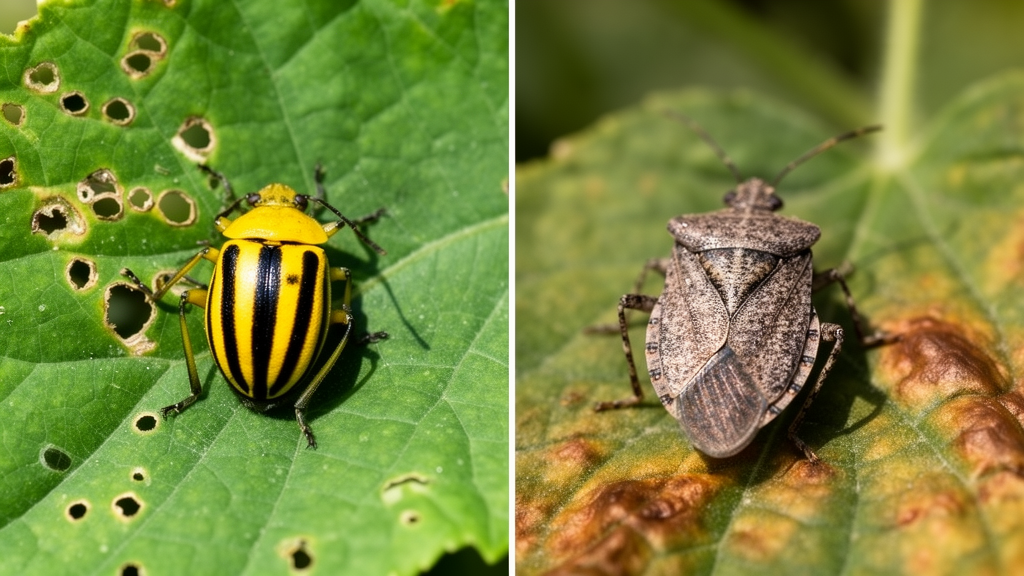
The striped cucumber beetle (Acalymma vittatum) is the most visually distinct of the two, and its appearance is a dead giveaway if you know what to look for. It is about a quarter of an inch long, oval-shaped, and bright yellow with three distinct black stripes running down its wing covers. It is the pest you see flying in early in the season, often before the vines have even reached three feet long. Because it is a beetle, it has hardened forewings (elytra) that cover its delicate flight wings. When it flies, it tucks those yellow stripes under and disappears, which is why you often only see them when they are feeding.
The damage caused by the striped cucumber beetle is twofold, and understanding this distinction is critical for your response. First, the adult beetle chews small, precise holes in the leaves, creating a distinctive ‘shot-hole’ pattern. This physical damage is unsightly, but it is rarely fatal to a mature, established vine. The real danger is what the beetle carries. The striped cucumber beetle is the primary vector for bacterial wilt and cucumber mosaic virus. It does not kill the plant by eating it; it kills the plant by infecting it. When the beetle feeds, it deposits bacteria into the plant’s vascular system, effectively clogging the water pipes. The plant wilts and dies from the inside out, regardless of how much you water it.
If you find a beetle with three stripes, your priority shifts immediately from pest control to disease management. You must assume the plant is already infected if it shows sudden, irreversible wilting. The solution for the beetle itself is physical exclusion. Because they are small and brightly colored, they are highly visible. Hand-picking them into a jar of soapy water is the most effective immediate action. However, the most reliable long-term defense is the use of floating row covers. These lightweight, translucent fabrics create a physical barrier that prevents the beetle from reaching the plant in the first place. You must install the covers immediately after transplanting seedlings and leave them on until the plants begin to flower, at which point you must remove them to allow pollinators access. This single step breaks the disease cycle before it ever starts.
The Squash Bug: The Sucking Assassin
The squash bug (Anasa tristis) looks nothing like a beetle. It is larger, roughly half an inch long, with a flat, shield-shaped body that is mottled gray or brown, designed to blend perfectly with dry soil and dead leaves. It does not have bright stripes. It does not fly well. It crawls. When you disturb a squash bug, it does not take flight; it tucks its legs and plays dead, dropping to the ground to wait for you to move on. This camouflage is why they are so difficult to spot until the damage is already severe.
The damage pattern of the squash bug is fundamentally different from the cucumber beetle because of its mouthparts. The squash bug is a piercing-sucking insect. It uses a needle-like proboscis to pierce the plant tissue and suck out the sap. This causes the leaves to curl, turn bronze, and eventually die from the edges inward. The plant does not wilt suddenly from bacterial infection; it slowly starves and dehydrates from the outside in. The most devastating damage, however, comes from the eggs and the nymphs. The female squash bug lays bronze-colored, bullet-shaped eggs in tight clusters on the underside of the leaves. These eggs are incredibly difficult to see, but they hatch into small, gray nymphs that feed in groups. A single cluster of eggs can produce dozens of nymphs that will strip a small vine bare in a matter of days.
Because the squash bug is a sucking insect, chemical sprays are often ineffective against the nymphs, and completely useless against the eggs. The eggs have a tough, waxy coating that repels almost all contact insecticides. This is why the identification of the pest dictates the treatment. If you find squash bugs, your first action must be to physically remove the egg clusters. Use your fingernail to scrape them off the underside of the leaves and drop them into soapy water. For adult bugs, the most effective organic treatment is kaolin clay. This is a fine white powder that mixes with water to form a microscopic barrier on the leaves. The bugs cannot penetrate the clay layer to feed, and they simply walk off the plant. It is a physical barrier, not a poison, making it highly effective against the squash bug’s specific feeding mechanism.
How to Tell Them Apart: The Wing Pattern Test
If you are standing in your garden, looking at a damaged vine, and you need to know whether you are dealing with cucumber beetles vs. squash bugs, you only need to look at one thing: the wing pattern. This is the definitive visual test that separates the two pests and dictates your entire management strategy.
Look at the back of the insect. If you see three distinct, longitudinal black stripes on a bright yellow background, you are looking at a striped cucumber beetle. This is a chewing pest that carries disease. Your response must be exclusion (row covers) and physical removal. If you see a mottled, shield-shaped gray or brown body with no stripes, you are looking at a squash bug. This is a sucking pest that starves the plant. Your response must be egg removal and kaolin clay application.
This distinction matters because the two pests attack the plant at different times and in different ways. The striped cucumber beetle appears early in the season, often before the vines have fully established. It is the first pest you will encounter in spring. The squash bug overwinters in leaf litter and debris, emerging later in the season when the vines are already heavy with fruit. By the time you see adult squash bugs, the damage is often already done. Recognizing the wing pattern allows you to intervene at the right time with the right tool, rather than reacting to the damage after the plant is already dying.
Why Misidentification Kills Your Vine
The most common mistake gardeners make is assuming that all cucumber pests are the same. They see a damaged vine, they see a bug, and they spray a broad-spectrum insecticide. This approach fails because it does not address the specific biology of the pest. When you spray for a cucumber beetle as if it were a squash bug, you are killing beneficial insects without stopping the disease vector. The beetle continues to feed, continues to carry bacteria, and continues to wilt your plants. When you spray for a squash bug as if it were a cucumber beetle, you are wasting money on sprays that cannot penetrate the egg shell, while the nymphs continue to feed in groups, stripping the vine bare.
The cost of misidentification is measured in lost yield. A single cucumber beetle can carry enough bacteria to kill a mature vine. A single cluster of squash bug eggs can produce enough nymphs to kill a seedling. By correctly identifying the pest, you can target your efforts precisely. You can use row covers to exclude the early-arriving beetle, and you can use kaolin clay to repel the late-arriving squash bug. You can save the plants that would otherwise be lost to disease or starvation.
The Honest Limits of Physical Control
It is important to state clearly where these physical control methods break down. Floating row covers are highly effective against cucumber beetles, but they are useless against squash bugs once the plants are flowering. You cannot cover a vine that needs to be pollinated. Once the cover is removed, the squash bug can re-enter the garden from the surrounding debris. This is why row covers must be paired with a secondary defense, such as kaolin clay or diatomaceous earth, for the squash bug. Similarly, kaolin clay is highly effective against the squash bug, but it washes off in heavy rain, requiring frequent reapplication. It also makes the leaves white, which can be unsightly in a mixed garden bed. These are not failures of the method; they are the constraints of the method. You must plan your garden layout to accommodate these limitations.
Furthermore, no physical barrier is 100% effective if the installation is imperfect. Even a small gap at the edge of a row cover can allow a cucumber beetle to enter. The cover must be sealed tightly to the ground with soil or rocks. If you are growing cucumbers in containers, the solution is even simpler: keep the plants indoors or in a greenhouse until they are large enough to handle external pests. This eliminates the risk entirely for the most vulnerable stage of the plant’s life.
The Payoff: A Garden That Actually Produces
Understanding the difference between cucumber beetles vs. squash bugs is not just an academic exercise. It is the difference between a garden that produces fruit and a garden that produces dead vines. By correctly identifying the pest, you can stop wasting time on ineffective treatments and start using the tools that actually work. The next time you see a damaged vine, do not reach for the spray. Look at the bug. Look at the wing pattern. And then act.
Sources & Further Reading
- Cucumber Beetles: Management Guidelines — University of Massachusetts Extension
- Squash Bug Management — Iowa State University Extension