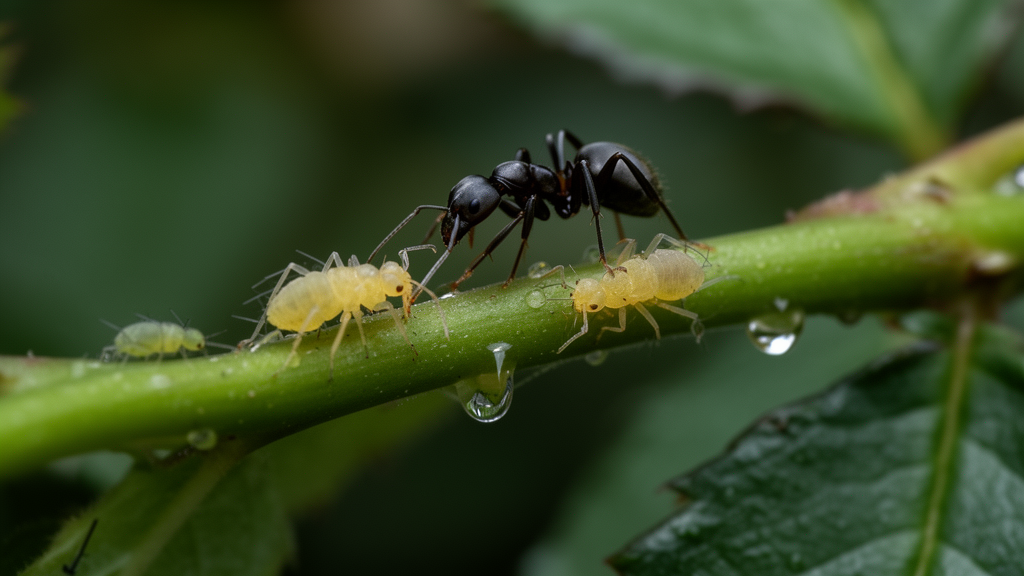
You walk past your rose bush and see it: a tight cluster of small, pear-shaped insects on the new growth. Your instinct is to grab the spray bottle or reach for the neem oil. You have spotted the enemy. But if you look closer, you will see ants marching up the stem, tapping the aphids with their antennae, and moving away with what looks like a sticky droplet on their abdomen. That is not a mistake. That is a transaction. The aphids are not just pests; they are livestock being farmed by a second, invisible species that is actively protecting them from the very predators you want to invite back into the garden.
This is the ant-aphid mutualism, and it is the single most common reason gardeners fail to control aphid populations, even when they spray with perfect accuracy. The spray kills the aphids, yes, but it does not kill the ants. And without the aphids to harvest, the ants will simply move to a new plant, or worse, they will start farming scale insects or mealybugs on your prized perennials. You cannot manage the aphids without managing the ants. This article explains exactly how to break the partnership, why standard sprays fail, and the specific physical barriers that actually work.
The Sticky Reward: Honeydew as a Currency
To understand why your sprays are failing, you have to understand what the aphids are actually doing. Aphids feed by inserting their stylet mouthparts directly into the phloem of a plant, tapping into the sugar-rich sap that the plant has spent energy creating. They consume far more sap than they need for basic survival. The excess sugar, which is incredibly dense and rich in amino acids, has to go somewhere. They excrete it as honeydew.
Honeydew is not a waste product to the aphid; it is the primary currency of the garden. It is also the primary currency to the ant. Ants have evolved to recognize honeydew as one of the most valuable food sources available in their environment. They will patrol a single plant for hours, sometimes days, waiting for an aphid to feed. When the aphid releases a drop, the ant collects it, stores it in its crop (a specialized stomach organ for liquid food), and carries it back to the colony to feed larvae and the queen.
This is not a one-time event. It is a continuous, active partnership. The ants will often physically position the aphids on the most nutrient-rich parts of the plant. They will move aphid colonies from dying leaves to healthy new growth. They will even build protective shelters out of leaves or soil to keep the aphids dry during rain. In exchange for this protection and transport, the aphids provide a steady, reliable stream of carbohydrates that allows the ant colony to explode in size. This is why you see more aphids on plants that have active ant colonies than on plants that do not.
Why Sprays Fail: The Ant Defense Mechanism
When you spray a plant with contact insecticide, you kill the aphids on the surface. But you are spraying a moving target that is being defended by a highly organized military force. The ants detect the death of their livestock almost immediately. They respond by becoming aggressive, biting the hands of the gardener, and launching a counter-offensive against the perceived threat.
More importantly, the ants will simply relocate the surviving aphids to a new, untreated plant. Because aphids reproduce so quickly, a single female can produce dozens of offspring in a week. If you kill 90% of the colony but leave 10% protected by ants, those 10% will repopulate the plant faster than if you had never sprayed at all. The ants ensure the survival of the colony by keeping it mobile and protected. Spraying without addressing the ants is like trying to drain a bathtub while the drain is plugged and the faucet is still running.
Furthermore, many systemic insecticides, which are absorbed by the plant and ingested by the aphids, are rendered less effective by the ants. Ants will groom the honeydew off the aphids, removing the chemical residue before it can be fully absorbed into the aphid’s system. They are, in a sense, washing off the poison. This is a well-documented phenomenon in entomology, where the presence of attending ants reduces the efficacy of both contact and systemic treatments by up to 50%.
The Physical Barrier: Breaking the Highway
The most effective way to stop the partnership is to physically prevent the ants from reaching the aphids. This is not about killing the ants; it is about evicting them from the property. Once the ants cannot reach the honeydew, they will abandon the aphids. Without the ants’ protection, the aphids are vulnerable to their natural predators, and the colony will collapse on its own.
The gold standard for this is the sticky barrier. You can use a commercial product like Tanglefoot, or you can make your own using a mixture of petroleum jelly and a small amount of cooking oil to prevent it from drying out. Apply a thick band of this sticky substance around the stem of the plant, just above the soil line. The ants cannot cross the sticky barrier. They will try, they will fail, and they will eventually move on to a plant where the highway is clear.
For potted plants, you can use a moat method. Place the pot inside a larger saucer filled with water. The ants cannot swim. This is particularly effective for indoor plants or patio containers where you can move the pot freely. For larger garden beds, you can create a trench around the base of the plant and fill it with a sticky substance or even diatomaceous earth, which acts as a physical abrasive that damages the ants’ exoskeletons, causing them to dehydrate.
It is important to note that these barriers must be maintained. Rain can wash away the sticky substance, and the ants will eventually find a way around it if it is not re-applied. Check your barriers every week, especially after a rainstorm. If you see ants crawling over the top of the barrier, you need to re-apply it immediately. This is a maintenance task, not a one-time fix.
Biological Warfare: Encouraging the Predators
Once you have broken the ant-aphid partnership, you can safely introduce the aphids’ natural enemies. The most effective predators are ladybugs (ladybird beetles), lacewings, and hoverfly larvae. These insects will hunt the aphids without the interference of the ants. However, you must be careful when introducing these predators. If the ants are still present, they will attack and kill the ladybugs and lacewings. The ants see the predators as a threat to their livestock and will defend the aphids aggressively.
Therefore, the sequence of operations is critical. First, break the ant highway. Second, allow the ant population to decline. Third, introduce the predators. This sequence ensures that the predators can do their job without being attacked by the ants. You can buy ladybugs and lacewings from garden centers, or you can attract them to your garden by planting flowers that provide nectar and pollen, such as dill, fennel, and yarrow. These plants also provide shelter for the predators, encouraging them to stay and reproduce.
It is worth mentioning that not all ants are equal in their farming behavior. Some species are more aggressive farmers than others. The odorous house ant (Technomyrmex spp.) and the pavement ant (Tetramorium caespitumum) are among the most common and effective aphid farmers in temperate regions. If you have these species in your garden, you will need to be more vigilant with your barriers. If you have fire ants, the situation is more complex, as they are aggressive and can be dangerous to handle. In that case, you may need to consult a local extension office for specific advice on managing fire ant colonies.
The Honest Limits: When Barriers Are Not Enough
Physical barriers and biological controls are the most sustainable way to manage aphids, but they are not a silver bullet. If you have a massive infestation, the aphids may cause enough damage to the plant before the ants are evicted and the predators arrive. In these cases, you may need to use a targeted spray to knock down the population quickly. However, you must use a spray that does not harm the predators you are trying to introduce. Insecticidal soap and neem oil are relatively safe for beneficial insects if applied correctly. Apply them in the evening when bees and other pollinators are not active, and avoid spraying the flowers directly.
Another limit is the type of plant you are growing. Some plants, such as citrus trees and certain ornamental shrubs, are highly attractive to aphids and ants. These plants may require more frequent monitoring and more robust barriers. If you are growing these plants, you may need to accept that you will have to manage the partnership continuously. It is a trade-off between aesthetic perfection and ecological balance.
The Payoff: A Garden That Fights Itself
Understanding the ant-aphid mutualism changes how you see your garden. You stop seeing aphids as the enemy and start seeing them as a symptom of a deeper imbalance. By breaking the partnership, you are not just killing bugs; you are restoring the natural order of things. You are allowing the garden to fight its own battles, using the tools it already has.
This approach takes more time and attention than spraying a bottle of poison. It requires you to look closer, to see the ants, to understand the honeydew, and to build the barriers. But the result is a garden that is more resilient, more balanced, and more beautiful. You will see more ladybugs, more lacewings, and more life. And you will save yourself the frustration of spraying the same plant over and over again, watching the aphids come back stronger than before. The next time you see ants on your rose bush, do not reach for the spray. Reach for the sticky tape. Let the ants go. Let the aphids be. Let the garden do the rest.