You have probably read the advice to cut a snake plant leaf and stick it in water. You have probably seen the diagrams showing a single leaf segment submerged in a glass jar, waiting for white roots to appear. It looks simple. It looks like the way the internet says you should propagate Sansevieria. But when you follow those instructions, your leaf turns to black mush within three weeks, and you are left wondering what you did wrong. The problem is not your water. It is not your light. The problem is that you are trying to force a rhizome-dependent plant to root from a leaf segment that was never designed to do it alone.
Snake plants do not propagate from leaves. They propagate from rhizomes. This is not a minor botanical distinction. It is the single most common reason people kill their Sansevieria during propagation attempts. When you cut a leaf and place it in water, you are severing it from the underground network that actually generates new growth. The leaf segment is dead weight the moment it is cut, and the attempt to root it is an exercise in rotting organic matter. Understanding the anatomy of the rhizome changes everything about how you propagate, store, and divide these plants.
The Rhizome Is the Engine, Not the Leaf
Sansevieria trifasciata, commonly known as the snake plant or mother-in-law’s tongue, is a rhizomatous plant. This means it grows from an underground horizontal stem called a rhizome. The rhizome pushes upward, sending out new leaves, and pushes outward, sending out new shoots. The leaves you see above the soil are merely the fruit of the rhizome’s labor. They are not the source of new plants. They are the output.
When you cut a leaf, you are cutting off the output. You are left with a piece of tissue that has no mechanism to generate roots. The leaf contains chlorophyll and structural fibers, but it lacks the meristematic tissue required to initiate root growth. Meristematic tissue is found in the rhizome, not in the leaf blade. Without that tissue, the leaf segment cannot root. It can only rot.
This is why water propagation fails. Water cannot create meristematic tissue. Water cannot force a leaf to grow roots. Water can only keep the leaf from drying out long enough for bacteria and fungi to break it down. The black, slimy mess at the bottom of your jar is not a failed root system. It is a decomposing leaf. The white roots you see in those viral videos are not coming from the leaf segment. They are coming from the tiny piece of rhizome that was left attached to the base of the cutting. If you cut that piece off, the leaf dies. If you leave it on, you are not propagating a leaf. You are propagating a rhizome section.
Why the Internet Loves the Water Method
The internet loves the water method because it is visual. It is satisfying. You put a piece of plant in water, and eventually, white roots appear. It feels like progress. It feels like success. But it is a trick. A successful one, in the sense that you end up with a rooted plant, but a failure in the sense that you did not propagate the leaf. You propagated the rhizome.
This distinction matters because it changes how you approach propagation. If you believe the leaf can root on its own, you will keep trying to force it. You will change the water. You will add rooting hormone. You will move the jar to a brighter window. None of these things will help. The leaf will rot. The rhizome will root. You will get a plant, but you will have killed the leaf in the process. And you will have learned nothing about how the plant actually grows.
The Royal Horticultural Society notes that Sansevieria is rhizomatous. This is a dry, technical way of saying that the plant’s survival depends on its underground stem. The leaf is a leaf. It photosynthesizes. It stores water. It does not generate new plants. The rhizome does. When you understand this, you stop trying to propagate the leaf and start propagating the rhizome. The results are immediate. The success rate is higher. The plants are stronger.
The Correct Method: Division and Offset Propagation
Snake plant propagation works through division. You take an established plant and separate the offsets. These are the new shoots that have grown from the rhizome but have not yet emerged from the soil. They are small versions of the parent plant, with their own leaves and their own root system. They are ready to be moved.
Here is how you do it. First, remove the parent plant from its pot. Shake off the excess soil. You will see the rhizome. It is a thick, horizontal stem that runs just below the surface. It may be buried, so you may need to gently dig around it. Look for the offsets. These are the smaller plants that have grown from the rhizome. They will have their own leaves and their own roots.
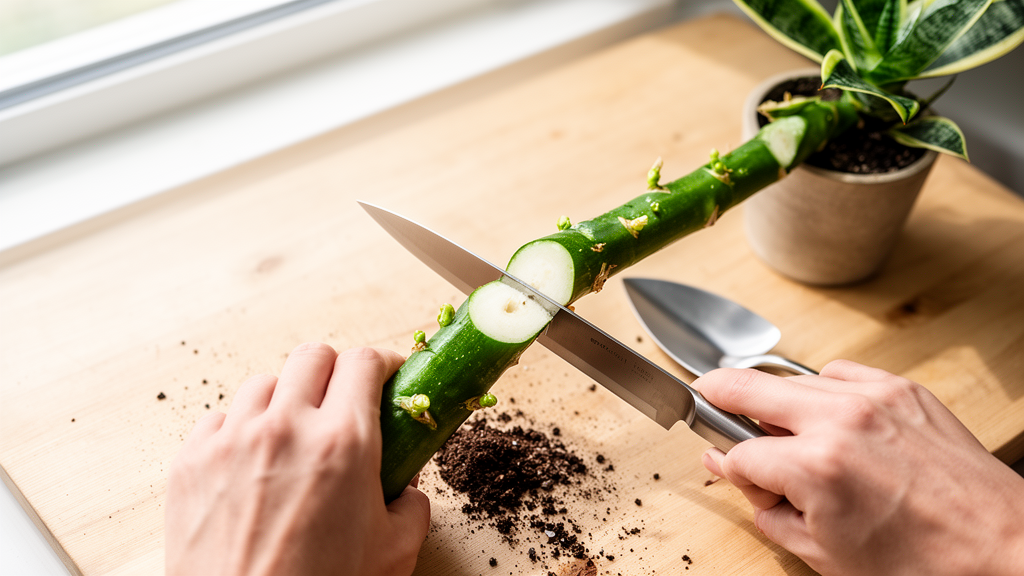
Using a clean, sharp knife, cut the offset away from the parent plant. Make sure you keep a piece of the rhizome attached to the offset. This is crucial. The rhizome contains the meristematic tissue that will allow the offset to continue growing. If you cut it off, the offset will die. Place the offset in a new pot with well-draining soil. Water it lightly. Keep it in bright, indirect light. It will grow.
This method is not as visually satisfying as the water method. You do not get to watch white roots appear in a glass jar. You get to dig in the dirt. But it works. It is the way the plant actually grows. And it is the way you should propagate your snake plants.
Leaf Cuttings: When They Actually Work
There is one exception to the rule. Leaf cuttings can work, but only if you include a piece of the rhizome. This is the method used by commercial growers. They take a leaf, cut it into segments, and attach each segment to a small piece of rhizome. They then plant the segment in soil. The rhizome generates roots. The leaf grows.
This is not leaf propagation. This is rhizome propagation using a leaf as a flag. The leaf is a flag. It tells you where the plant is. It does not generate the plant. If you try to root a leaf segment without the rhizome, it will rot. If you include the rhizome, it will grow. The difference is the rhizome.
Why do commercial growers use this method? Because it is efficient. They can take one plant and generate dozens of new plants from it. They can do this quickly. They can do this at scale. But they are not propagating the leaf. They are propagating the rhizome. The leaf is just a flag.
What You Should Do Instead
If you want to propagate your snake plant, divide it. Wait until the plant is established. Wait until it has produced offsets. Then, follow the steps above. Remove the plant from its pot. Separate the offsets. Plant them in new pots. Water them lightly. Keep them in bright, indirect light. They will grow.
This is not the only way to propagate a snake plant. You can also propagate it from seeds. But seeds are rare. They are difficult to obtain. They take years to grow. Division is faster. Division is easier. Division is the way most gardeners propagate their snake plants.
If you have tried the water method and failed, do not feel bad. You were following bad advice. The internet is full of bad advice. It is visual. It is wrong. Stop trying to propagate the leaf. Start propagating the rhizome. The results will be better. The plants will be stronger.
Snake plants are tough. They are resilient. They are forgiving. But they are not magic. They do not root from leaves. They root from rhizomes. Understand this, and you will never fail at propagation again.