You pull a rosemary stem and it comes away like wet cardboard, snapping clean at the base with no resistance. The leaves are still green, still clinging to the stem, and the plant looks perfectly fine from a distance. But the stem is mushy. You set it aside, assuming it was just a bad branch, and reach for the next one. That is when you realize the whole plant has turned to a dark, slimy collapse from the soil line up. It did not dry out. It did not freeze. It rotted from the inside, and you are looking at the corpse of a Mediterranean shrub that never stood a chance in your soil.
Most gardeners assume rosemary dies because of cold, or because they forgot to water it, or because the pot is too small. None of those things kill rosemary. Rosemary dies because it is root rotting, and the rot starts the moment you plant it in soil that holds water. Rosemary is not a thirsty plant. It is a drought-adapted Mediterranean shrub that evolved to grow on rocky, well-drained hillsides where its roots dry out completely between rain events. When you give it standard potting mix, you are giving it a swamp. The roots suffocate, the tissue breaks down, and the plant collapses before you ever see a yellow leaf.
The problem is not the water. The problem is the soil structure. Standard bagged potting mixes are designed for tropical houseplants and thirsty annuals. They hold water. They hold it tightly. Rosemary does not want water held tightly. It wants water to pass through, quickly, and leave the roots dry. When you plant rosemary in a standard 50/50 peat-perlite mix, the water sits around the root ball for days. The root cells cannot respire. They begin to die. The rot moves upward, and by the time the leaves yellow, the damage is already irreversible.
Why Standard Potting Mix Kills Rosemary
Peat moss, the primary ingredient in most bagged potting mixes, is hydrophobic when it dries out. It repels water. When you water a rosemary plant in peat-heavy soil, the water runs down the sides of the root ball and pools at the bottom of the pot, leaving the middle of the root zone bone dry. The plant is simultaneously drowning at the base and starving for water at the top. The roots in the wet zone rot. The roots in the dry zone shrivel. The plant is caught in a biological vise, and it dies from the stress of both extremes.
Perlite helps, but not enough. Most commercial mixes use 10 to 20 percent perlite. That is enough for a pothos. It is not enough for rosemary. Rosemary needs 40 to 50 percent inorganic grit. That grit creates the air pockets that allow the roots to breathe. Without those air pockets, the soil becomes a solid block of wet peat within a week. The roots cannot grow into it. They cannot push through it. They simply sit there, suffocating, until the fungal pathogens that live in every potting mix find an open door and move in.
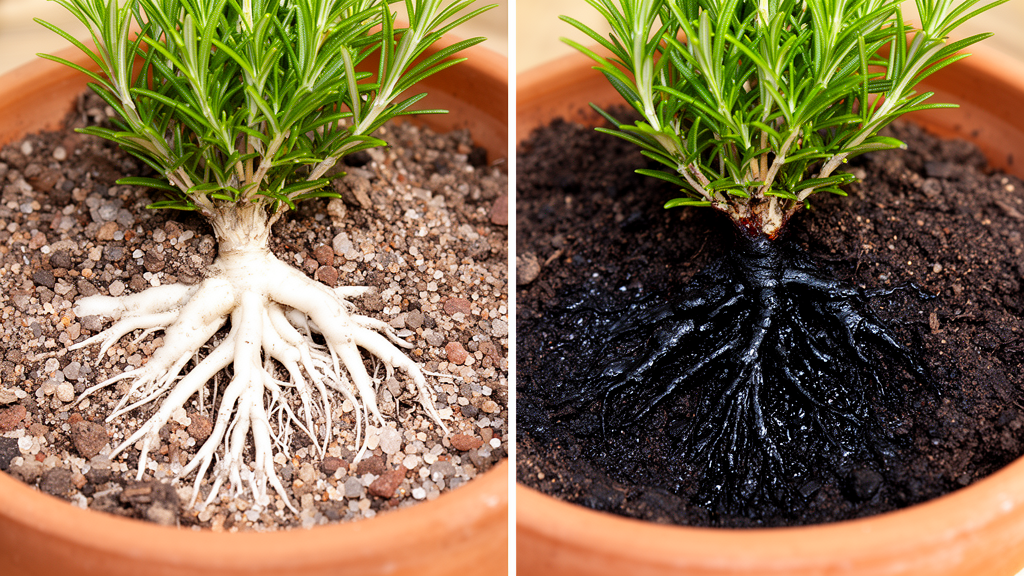
The fungal pathogens are not the primary cause of death. They are the cleanup crew. The primary cause is the soil structure. Once the roots are damaged by anaerobic conditions, fungi like Phytophthora and Pythium move in and digest the root tissue. You see the result as a black, slimy stem at the soil line. You might think you need to treat the fungus. You do not. You need to change the soil. If you treat the fungus without changing the soil, the plant will die again in the next watering.
How to Build the Right Soil
Building the right soil for rosemary is not complicated. It is a matter of ratios. You need a mix that drains instantly, holds almost no water, and provides enough structure to anchor the plant. A simple recipe works: one part pine bark fines, one part coarse horticultural sand, one part pumice or scoria, and zero peat moss. Pine bark fines provide slow-release organic matter and structure. Coarse sand prevents compaction. Pumice or scoria provides permanent air pockets that never break down. This mix dries out in two days, even in a humid climate. That is exactly what rosemary wants.
If you cannot find pumice or scoria, use three parts coarse sand to one part pine bark fines. If you must use peat moss, limit it to 10 percent of the total volume, and mix it with 40 percent perlite. Do not use fine sand. Do not use topsoil. Do not use compost. Compost holds water and releases nitrogen, both of which rosemary hates. Rosemary grows best in lean, alkaline, gritty soil. It does not need food. It needs drainage.
How to Save a Dying Rosemary Plant
If your rosemary is already showing signs of rot, do not spray it. Do not add more water. Do not wait for it to dry out. You need to repot it immediately. Remove the plant from its pot. Shake off as much of the old soil as possible. Inspect the roots. Healthy roots are white and firm. Rotting roots are black, slimy, and smell like a swamp. Cut away all the black roots with clean, sharp shears. Cut back the stem to healthy, white tissue. If the stem is black at the soil line, cut it back until you see white, healthy tissue inside. If there is no white tissue left, the plant is dead. Throw it away.
Once you have cut back to healthy tissue, let the cuttings dry for 24 hours. This allows the wounds to callus over, which prevents the fungal pathogens from entering the fresh cuts. Then, plant the rosemary in your new gritty mix. Do not water it immediately. Wait three days. Then, water it lightly, just enough to settle the soil around the roots. After that, water only when the soil is completely dry. This means you will water it far less frequently than you think. Rosemary in gritty soil may only need water once every two weeks, even in summer. In winter, it may need water once a month. Let the soil dry out completely between waterings. That is the key.
Why Rosemary Looks Fine Until It Dies
The most confusing part of rosemary root rotting is that the plant looks healthy until it does not. The leaves stay green. The stems stay upright. The plant does not wilt. This is because rosemary is a succulent-like shrub. It stores water in its leaves and stems. It can survive for weeks without water, and it can survive for weeks in wet soil. The leaves do not yellow. They do not drop. The plant simply stays green while the roots are being digested by fungi. By the time the leaves start to yellow, the root system is gone. The plant is already dead. It is just taking a few days to catch up.
This delayed reaction is why rosemary is so difficult to save. Gardeners water it when they see yellow leaves, thinking it is dry. They are watering a dead plant. They are adding more water to a root system that is already rotting. They are accelerating the death. The only way to save a yellowing rosemary is to repot it, cut back the rot, and let the remaining healthy roots dry out. If you water it after repotting, you will kill it again.
How to Water Rosemary Correctly
Watering rosemary correctly is counterintuitive. You must water it deeply, but infrequently. When you water, pour enough water to soak the entire root zone. Then, wait. Do not water again until the soil is completely dry. This means you will wait longer than you think. In a gritty mix, this might be two weeks. In a standard mix, this might be three days. The soil must be dry to the touch, and the pot must feel light. If you are unsure, stick your finger two inches into the soil. If it is damp, do not water. If it is dry, water it.
Do not use saucers. Do not let the pot sit in water. Rosemary hates wet feet. If you use a saucer, empty it immediately after watering. If you use a self-watering pot, do not use it for rosemary. The constant moisture will kill it. Rosemary needs to dry out completely between waterings. It needs to feel the stress of drought. That stress triggers the essential oils that give rosemary its flavor and fragrance. A stressed rosemary is a fragrant rosemary. A happy rosemary is a bland rosemary.
Planting rosemary in the right soil is the single most important thing you can do for the plant. It is a Mediterranean shrub that evolved to grow on rocky hillsides. Treat it like one. Give it gritty soil. Water it infrequently. Let it dry out completely. It will thrive. It will grow. It will produce fragrant, flavorful leaves. It will not rot. It will not die. It will survive. That is the secret to growing rosemary. It is about soil. Change the soil, and you change the plant.