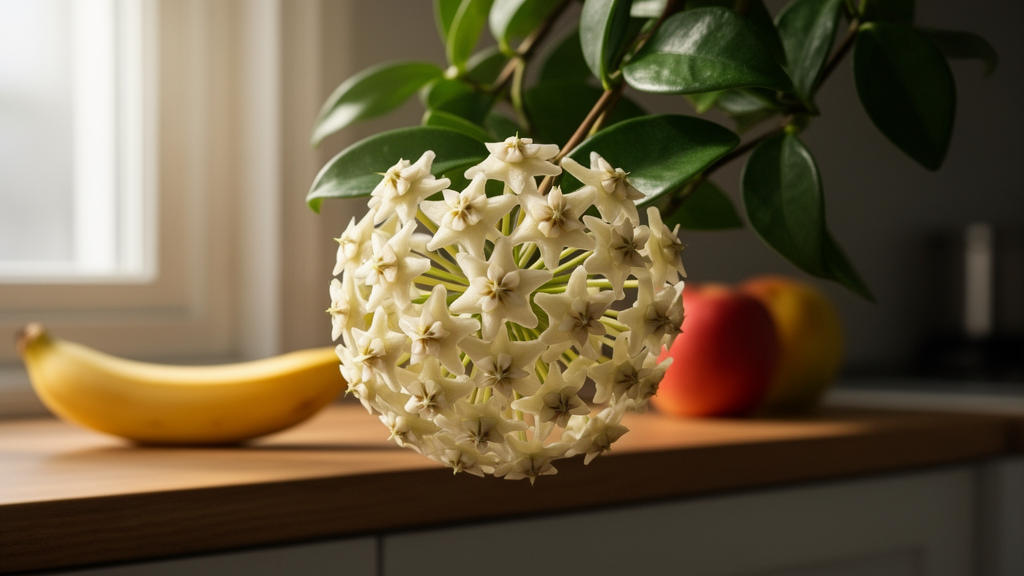
A wax plant (Hoya carnosa) in a dark apartment corner rarely flowers. It grows leaves, it sends out long vines, and it sits there for years. Then a plant owner moves it, or the apartment gets a new window treatment, or the temperature swings a few degrees in winter, and suddenly the plant pushes out a cluster of star-shaped blooms. The owner assumes the plant was just waiting for the right moment. It was not. The plant was waiting for a specific chemical signal that most indoor growers never notice.
That signal is ethylene gas. It is a natural plant hormone, a simple hydrocarbon molecule that acts as a ripening trigger in fruits and a flowering trigger in certain houseplants. Your wax plant does not bloom because you watered it correctly or gave it perfect light. It blooms because a burst of ethylene reached its stems, and that burst usually comes from somewhere you would not expect.
Ethylene is not something you buy. You do not spray it on your plants. It is produced by decaying organic matter, by ripening fruit, by burning candles, and by certain building materials off-gassing over time. When a wax plant is exposed to even a small, localized increase in ethylene concentration, it interprets that stress as a signal that conditions are changing. The plant responds by shifting energy from vegetative growth into reproductive effort. It blooms.
This is not a rare anomaly. It is a documented physiological response in the Asclepiadaceae family, which includes Hoyas. The mechanism has been studied in commercial greenhouse operations where ethylene exposure is used to synchronize flowering in ornamental crops. The same mechanism happens in your living room, only slower and less predictable.
Most growers try to force wax plants to bloom by adjusting light, water, or fertilizer. None of those things trigger the initial flower spike. Light determines whether the plant survives and how fast it grows. Water determines whether the roots stay healthy. Fertilizer determines how many leaves it puts out. Ethylene determines whether the plant even attempts to flower. Without that chemical signal, you can give a wax plant perfect conditions for a decade and it will never bloom. With the signal, it will bloom even in mediocre conditions.
The trick is understanding where ethylene comes from indoors. It is not coming from the plant itself. Mature wax plants produce negligible amounts of ethylene. The gas comes from external sources, and those sources are often things you keep in the same room.
Ripening fruit on the counter is the most common source. A single banana or apple sitting near a wax plant can raise the local ethylene concentration enough to trigger a bloom cycle. This is why wax plants in kitchens or dining areas sometimes bloom more often than identical plants in bedrooms. The gas accumulates in the microclimate around the leaves, and the plant’s receptors pick it up. The effect is dose-dependent and cumulative. A small amount over several weeks can be enough. A large amount over a few days can trigger a rapid response.
Burning candles, especially paraffin-based ones, release small amounts of ethylene along with other hydrocarbons. This is not the primary source for most growers, but it is a contributing factor in homes where candles are burned regularly. The gas disperses quickly, so the effect is localized and short-lived. It rarely triggers a bloom on its own, but it can push a plant that is already close to the threshold over the edge.
Off-gassing from new furniture, carpets, or building materials is another source. New plywood, pressed wood, and certain adhesives release ethylene as they cure. This is why wax plants placed in newly renovated rooms or near freshly installed cabinets sometimes bloom for the first time. The off-gassing slows over months, but the initial burst can be enough to trigger a flowering response.
Stress from repotting or root disturbance can also contribute. When you repot a wax plant, you damage some of the fine root hairs. The plant interprets this physical stress as a signal that conditions are changing. Combined with even a small amount of ambient ethylene, the stress can be enough to trigger a bloom. This is why wax plants sometimes bloom after repotting, even when the repotting itself was not stressful. The plant is responding to the combination of physical disturbance and chemical signaling.
Temperature fluctuations play a role too. A drop of five to ten degrees at night, especially in winter, can signal to the plant that conditions are shifting. This is not the primary trigger, but it lowers the threshold for ethylene to have an effect. Plants that experience seasonal temperature swings in their native habitats are adapted to use temperature as a secondary signal. Your wax plant is no different.
The practical takeaway is simple. If your wax plant refuses to bloom, stop adjusting light and water. Start looking for ethylene sources. Move the plant away from fruit bowls. Check for off-gassing materials. Consider whether recent renovations or new furniture might be contributing. You do not need to do anything special. You just need to notice what is already happening in the room.
Once the plant blooms, the flower cluster (called a corymb) will last for weeks. The individual flowers open over several days, each one lasting two to three days before wilting. The scent is often sweet and heavy, sometimes too strong for small rooms. This is normal. The plant is doing exactly what it is supposed to do when it receives the right signal.
After the blooms fade, the plant will return to vegetative growth. The flower spike will not bloom again. Wax plants produce new flower spikes from the same nodes year after year. The old spike remains alive and can produce multiple flushes of blooms over several seasons. This is why a mature wax plant can bloom repeatedly from the same area, even though each individual flower only lasts a few days.
If you want to encourage blooms, you can experiment with ethylene sources. Place a ripening banana or apple in a paper bag near the plant for a week. Remove the fruit before it over-ripens and starts to rot. Watch for flower spikes. This is not a guarantee, but it is a way to test whether your plant is ethylene-responsive. Most wax plants are. A few are not, and those plants will never bloom regardless of what you do.
The deeper lesson here is about how houseplants communicate with their environment. They are not passive decorations. They are reading chemical signals from the air around them, responding to stress, and making decisions about when to invest energy in reproduction. Understanding that process changes how you approach every houseplant, not just wax plants.
When you stop trying to force blooms and start paying attention to the signals your plants are already receiving, you will notice patterns. You will see why some plants bloom and others do not. You will understand why a plant that sat quietly for years suddenly flowers after a renovation or a moved fruit bowl. The plant was never waiting for you to do something right. It was waiting for the air to tell it to bloom.