You open the bag, the smell hits you peat, perlite, maybe a little bark and you think: this is soil. You dump it into a five-gallon bucket, plant your strawberry runners, water them in, and three weeks later the leaves are yellowing at the edges, the plant is stalling, and you’re wondering what you did wrong. The answer is in the bag, and it’s not what you think.
Commercial bagged potting mixes are engineered for houseplants and general container gardening. They are not engineered for fruiting crops like strawberries. The problem isn’t that the mix is bad it’s that it’s doing exactly what it was designed to do, and strawberries need something different. When you plant strawberries in standard potting mix, you’re giving them a medium that holds too much water, breaks down too fast, and locks out the nutrients they actually need to produce fruit. The fix is simple once you know what to look for.
The Three Flaws in Standard Potting Mix
Standard bagged potting mix contains three ingredients that work against strawberry production. Understanding what each one does and why it fails in a fruiting crop is the difference between a plant that stalls and one that produces all season.
Peat moss holds water like a sponge. That’s its purpose. It’s also its problem for strawberries. Peat holds water until the plant can’t extract it anymore, then holds it longer. Strawberries have shallow, fibrous roots that hate sitting in saturated medium. When peat stays wet past the point of root comfort, the plant shifts energy from fruit production to root survival. The leaves yellow. The runners stop. The plant goes dormant while the season is still moving forward.
Perlite is inert, but it changes the mix’s drainage curve. In a houseplant mix, perlite creates air pockets. In a container growing strawberries, perlite accelerates drainage past the point where the roots can access water consistently. The result is a cycle: water the plant, the mix drains fast, the roots dry out, you water again, the mix re-saturates, the peat holds it, the roots sit in wet medium. This cycle is the single most common cause of inconsistent strawberry production in containers. The plant isn’t dying. It’s being asked to fruit in a medium that can’t hold the right balance of water and air.
Bark decomposes on a timeline that doesn’t match a strawberry’s productive life. Standard potting mix uses aged bark or composted wood chips. They break down over 1218 months. A strawberry plant in a container is productive for 1218 months. The timeline matches until month eight, when the bark begins to collapse, the structure fails, the mix compacts, and suddenly your well-draining container is holding water like a bucket. This is why strawberry plants in standard potting mix often produce well in year one and stall in year two the medium has physically changed beneath them.
What Strawberry Containers Actually Need
Strawberries need three things from their growing medium: fast drainage that doesn’t accelerate past root reach, consistent moisture retention without saturation, and a structure that holds for the plant’s productive life. No standard bagged mix delivers all three. You have to build it.
The base is coarse pine bark fines, not peat. Replace 5060% of the peat in your mix with screened coarse pine bark fines (the kind sold as mulch, screened to 1/4 inch or smaller). Pine bark holds air, drains fast, and breaks down over 23 years long enough to support a strawberry plant’s productive cycle. It also resists compaction, which is the silent killer of container strawberries.
Add compost, not just perlite. Replace 2030% of the remaining volume with well-aged compost. Compost provides slow-release nutrients, introduces microbial life, and holds moisture in a way that peat cannot it holds it at the root zone, not in a saturated block. The microbes in compost also help strawberries access nutrients that standard mix locks up. This is why plants in compost-amended mixes produce more fruit even when the nutrient count on the bag looks identical.
Keep the perlite, but reduce it. Standard mix uses 2030% perlite. For strawberries, drop it to 1015%. You still want the air pockets, but you don’t want the drainage to outpace the roots’ ability to track it. The goal is a medium that drains in 3060 seconds when you water, not 510 seconds.
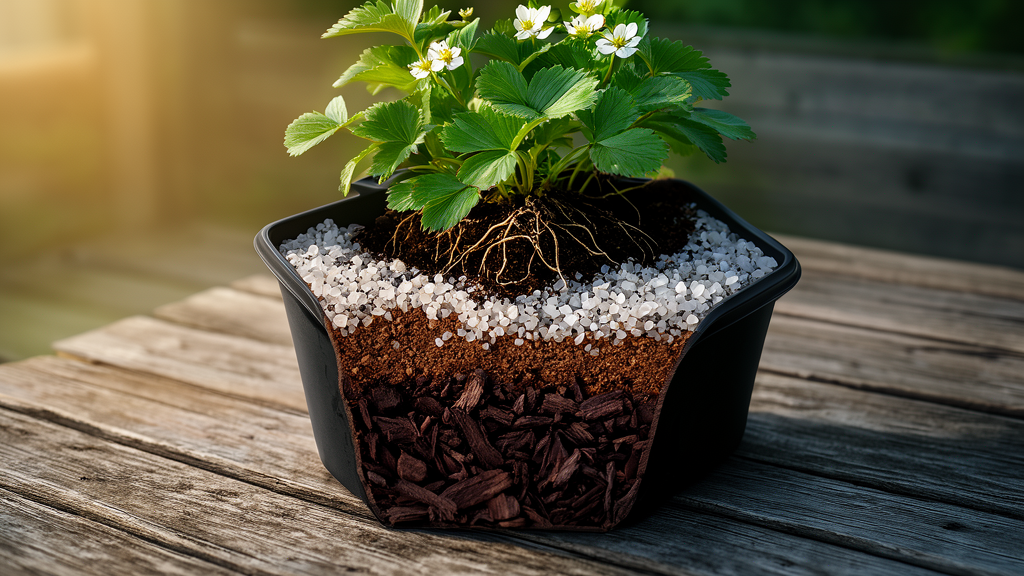
The ratio that works: 55% coarse pine bark fines, 25% well-aged compost, 15% perlite, 5% worm castings. Mix it thoroughly. Fill your container. Plant your runners. Water it in. The plant will respond within two weeks with new growth and, if you’re planting in spring, fruit within six to eight weeks.
When Standard Mix Actually Works
Standard potting mix isn’t wrong. It’s just wrong for strawberries. It works perfectly for leafy greens in containers, for herbs, for ornamental bedding plants, for anything that doesn’t need to push fruit through a shallow root system. If you’re growing lettuce, basil, or marigolds in a five-gallon bucket, standard mix is fine. Strawberries are a different crop with different root behavior. Treating them the same is why so many container strawberry plants stall.
There’s one exception: if you’re growing strawberries in a self-watering container, standard mix can work but only if you modify it. Self-watering reservoirs keep the bottom of the medium saturated. Standard peat-based mix will stay saturated there until the plant gives up. If you’re using a self-watering system, you must replace the bottom third of the mix with coarse pine bark fines and reduce the perlite to 5%. The reservoir will do the rest. But this is a specific system, not a general recommendation.
What to Do If You’ve Already Planted in Standard Mix
If your strawberries are already in standard potting mix and showing yellow leaves, stalling, or producing poorly, don’t panic. You can fix this without replanting, but you have to act within the next two weeks once the roots have fully colonized the bad medium, the fix gets harder.
Step one: flush the medium. Water the plant heavily until water runs freely from the drainage holes. Do this three times, one day apart. This pushes the saturated peat past the root zone and resets the moisture balance. It won’t fix the structure, but it will give the plant a breathing room to recover while you prepare the fix.
Step two: top-dress with the corrected mix. Remove the top 23 inches of the existing medium. Replace it with a blend of 50% coarse pine bark fines, 30% compost, 15% perlite, 5% worm castings. Gently work it into the existing medium don’t tear the roots, just encourage them to migrate upward into the better zone. Water it in. The plant should show new growth within 1014 days.
Step three: monitor moisture closely. For the next three weeks, water only when the top 1.5 inches of the mix are dry. Strawberries in mixed medium need less water than they did in pure peat, because the pine bark and compost hold moisture differently. Overwatering at this stage will undo the fix.
The Long Game: When to Replace the Medium
Even with the corrected mix, container strawberries need the medium replaced every 1218 months. The bark will eventually break down. The compost will be consumed. The perlite will settle. When the plant stops producing fruit despite good light and watering, the medium is the first thing to check. Pull the plant out. If the mix has compacted, darkened, or holds water like a sponge, replace it. Don’t top-dress again. Replace it entirely.
This is the cycle every container strawberry gardener learns: plant, produce, stall, replace. The plants that produce all season are the ones whose medium was built for them from the start, not adapted after the fact. The difference isn’t fertilizer. It’s the medium’s structure.
FAQ
Can I use standard potting mix for strawberries if I water less? No. The problem isn’t watering frequency. It’s the medium’s water-holding curve. Strawberries need fast drainage that doesn’t accelerate past root reach. Standard mix can’t deliver that, regardless of how often you water.
Is peat moss bad for strawberries? Peat moss isn’t bad. It’s just wrong for them in standard mix ratios. Peat holds water until the plant can’t extract it, then holds it longer. Strawberries with shallow roots can’t survive that. Replace 5060% of the peat with coarse pine bark fines and the problem disappears.
How often do I need to replace container strawberry mix? Every 1218 months. The bark breaks down, the compost is consumed, the structure collapses. When the plant stops producing despite good light and watering, replace the medium entirely. Top-dressing works for one season. Full replacement is required for the next.
What’s the cheapest way to build strawberry mix? Screened coarse pine bark fines (mulch grade) are the cheapest base. Buy it by the cubic yard from a landscape supplier, screen it through a 1/4-inch hardware cloth, and you’ve got your base for under $2 per plant. Compost is next buy it by the cubic yard, screen it, and you’re under $5 per plant total. Perlite and worm castings are optional but worth the small cost.
Can I grow strawberries in a self-watering container with standard mix? Only if you modify it. Replace the bottom third with coarse pine bark fines and reduce perlite to 5%. The reservoir keeps the bottom saturated, and standard peat-based mix will stay saturated there until the plant gives up. This is a specific system, not a general recommendation.