Falls from six stories kill more cats than falls from twenty. The same counter-intuitive math applies to your Monstera deliciosa, and it is the single reason your plant keeps dropping leaves while the neighbor’s identical plant thrives on a north-facing window. The problem is not that your plant is dying. The problem is that you are giving it too much light, and the plant is shedding leaves to survive the overload.
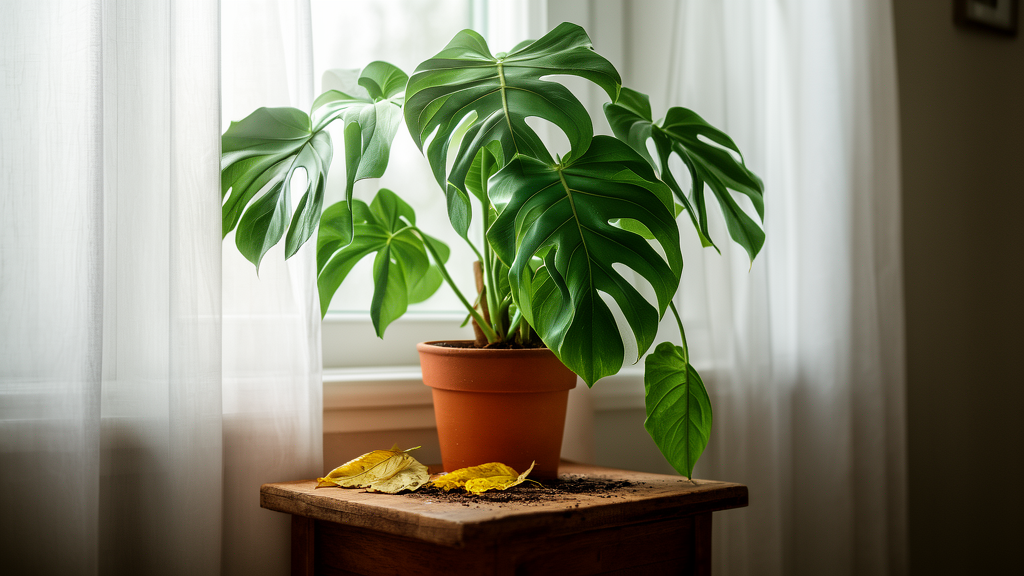
Monstera deliciosa is a jungle-floor vine. It grows under the canopy of taller trees, where sunlight arrives in dappled patches, never direct. When you place it on a south-facing windowsill, you are not giving it a “bright” spot. You are giving it a solar oven. The plant responds by dropping leaves, not because it is sick, but because it is conserving energy. Each leaf is a solar panel, and too many panels in direct sun cook the tissue. The plant sheds them to reduce the load. This is not neglect. This is over-care.
Why Direct Sun Cooks a Monstera
The leaf tissue of Monstera deliciosa is adapted to filtered light. The chloroplasts in the upper cells are optimized for low-to-moderate intensity, not the full spectrum of unfiltered sunlight. When direct sun hits the leaf, the photosynthetic machinery becomes overloaded. The plant cannot process the energy fast enough, so it generates reactive oxygen species, free radicals that damage cell membranes and chlorophyll. The visible result is bleached, crispy patches, often starting at the leaf edges, and eventually yellowing and drop.
This is why your plant drops leaves even when you water it perfectly. The water uptake cannot compensate for the photodamage. The plant is essentially saying: “I cannot support this many leaves in this light. I am shedding them to stay alive.” The solution is not more water. The solution is less light.
How to Read Your Light Situation
Most houseplant guides say “bright, indirect light.” This is useless. It tells you nothing about the actual photon flux your plant receives. You need a concrete way to measure it.
Here is the test: place your hand at the height of the plant’s lowest leaf, palm up, at noon on a sunny day. If you feel heat on your palm, the light is too strong. If you feel warmth but no burn, it is acceptable. If you feel nothing, it is too low. This is not a perfect measurement, but it is a practical one. It tells you whether the light is direct, filtered, or ambient.
For a Monstera, the ideal is bright, indirect light, roughly 100 to 250 micromoles per square meter per second (μmol/m²/s). You can measure this with a cheap light meter, or you can use the hand test. If your plant is on a south-facing window with sheer curtains, you are likely in the right range. If it is on a south-facing window without curtains, you are in the danger zone. If it is on a north-facing window, you are under-lighting it.
What to Do When Leaves Drop
When your Monstera drops leaves, do not panic. Do not increase watering. Do not fertilize. The plant is signaling that it is stressed by light overload. The first step is to move it. Place it one to two feet back from the window, or behind a sheer curtain. If you cannot move it, hang a shade cloth (30–50% density) over the window. This reduces the photon flux without eliminating the light entirely.
Do not remove the dropped leaves yourself. The plant is reabsorbing nutrients from them. If you pull them off, you force the plant to expend energy on new growth instead of recovering. Wait until the leaf turns completely brown and dry, then snip it at the petiole. This is not neglect. This is triage.
Watering should remain consistent, when the top two inches of soil are dry, water thoroughly until it drains from the bottom. Do not let the plant sit in standing water. Do not water on a schedule. Water when the soil is dry. This is the single most important rule for Monstera care, and it is the one most people get wrong.
Why Your Neighbor’s Monstera Thrives
Your neighbor’s Monstera is on a north-facing window. It receives low, cool light. It grows slowly. It drops almost no leaves. It looks smaller. It looks “lazy.” But it is not dying. It is thriving in the conditions it is adapted to. Your plant is on a south-facing window. It receives high, hot light. It grows fast. It drops leaves. It looks “stressed.” But it is not dying. It is adapting to conditions it is not adapted to.
This is the core misunderstanding of houseplant care: we judge plants by human standards of “bright” and “dark.” A north-facing window is bright to us. It is dim to a jungle-floor vine. A south-facing window is bright to us. It is blinding to a jungle-floor vine. The plant does not care about your comfort. It cares about its own physiology. The goal is not to give the plant what you think is bright. The goal is to give it what it evolved to receive.
The Honest Limits of This Advice
This advice works for Monstera deliciosa, the most common houseplant species in this genus. It does not work for Monstera adansonii, which has smaller leaves and slightly different light requirements. It does not work for Monstera obliqua, which is rarer and more light-sensitive. It does not work for Philodendron hederaceum, which is often confused with Monstera but has different light tolerances. If your plant is one of these, the advice may need adjustment.
Additionally, this advice assumes your plant is healthy. If it is root-bound, pest-infested, or suffering from root rot, light adjustment alone will not save it. Address those issues first. Light is only one variable in plant health. It is the most common one, but not the only one.
What This Changes About How You See Your Plant
Your Monstera is not broken. It is not dying. It is not neglecting you. It is doing exactly what it evolved to do: survive in the understory of a tropical forest. When you place it in direct sun, you are asking it to do something it cannot do. It drops leaves to survive. This is not failure. This is resilience. The plant is telling you, in the only language it has, that it needs less light. Listen to it. Move it back. Give it time. It will recover. It always does.