
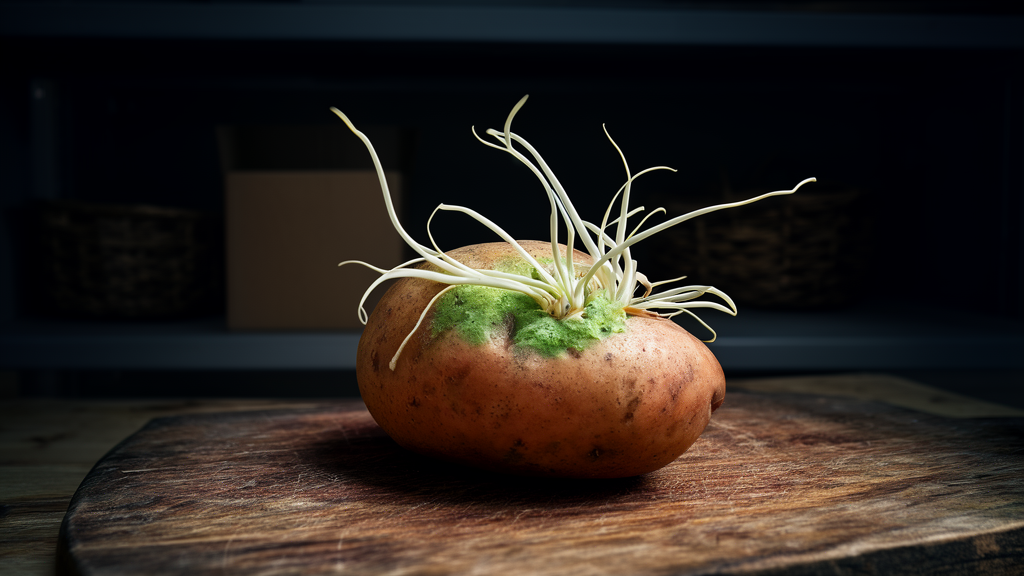
You open the pantry door and see it: a russet potato, its skin flushed with a faint blue-green near the eyes, sending up long, pale tendrils that look like they belong to a houseplant. Your instinct is to snap the sprouts, peel the green, and toss it into a soup pot. That instinct is wrong, and it is costing you food.
Those pale shoots are not the problem. The problem is what happens when those shoots are left in direct light: they turn green, and the green skin is a chemical warning. The potato is producing solanine, a glycoalkaloid toxin that your digestive system does not want to process. The sprouts themselves are edible, but the green skin is not. The rule is simple: do not eat the green parts. The green parts are the plant’s defense mechanism, and it is working exactly as designed.
What Are Green Potatoes, Really?
When people ask “what are green potatoes,” they are usually looking for a safety verdict, not a biology lesson. The answer is straightforward: a green potato is a tuber that has been exposed to light and responded by producing chlorophyll and solanine. The green color itself is harmless—it is just chlorophyll, the same pigment that turns leaves green. But chlorophyll is a marker. It tells you that the potato is actively producing glycoalkaloids, specifically solanine and chaconine, to defend itself from being eaten.
Solanine is heat-stable. Boiling, baking, or frying a green potato does not destroy the toxin. The only way to remove it is to cut away the green parts. How much you need to cut away depends on how far the toxin has penetrated. A surface-level green tint means you can peel it. A deep, widespread green means the tuber is past saving.
How to Tell If a Potato Is Safe to Eat
Not every green potato is a lost cause. The USDA and food-safety guidelines agree on a simple test: taste. If a thin slice of the peeled potato tastes bitter, the solanine concentration is too high. Bitterness is your signal to discard it. If it tastes normal, you can eat it after peeling away all the green skin and eyes.
Here is the practical breakdown:
- Surface green tint after peeling: Safe to eat. The toxin has not penetrated deep into the flesh.
- Deep green streaks running into the flesh: Discard. The glycoalkaloids have migrated into the edible tissue.
- Bitter taste after peeling: Discard. Bitterness is the definitive marker of high solanine levels.
- Long sprouts with no green skin: Safe to eat. The sprouts themselves are edible, though they draw nutrients from the tuber, making it softer and less flavorful.
When in doubt, throw it out. The cost of one potato is not worth the nausea, headache, or digestive distress that solanine poisoning can cause.
How to Store Potatoes So They Do Not Turn Green
Prevention is the only reliable fix. Potatoes are tubers. They are designed to sit underground in darkness, waiting for spring. When you store them in a bright kitchen, you are triggering their survival response. Here is how to store them correctly:
Darkness: This is the single most important factor. Store potatoes in a dark place. A pantry cupboard, a basement, or a cardboard box works. Do not store them in a clear plastic bag on the counter. Light is the trigger for chlorophyll and solanine production.
Cool temperature: Ideal storage temperature is 45 to 50 degrees Fahrenheit (7 to 10 degrees Celsius). A basement or root cellar is perfect. A warm kitchen accelerates sprouting and green skin development.
Airflow: Potatoes need to breathe. Store them in a paper bag, a cardboard box, or a woven basket. Do not store them in a sealed plastic bag. Trapped moisture encourages rot.
Keep them away from onions: Onions release gases and moisture that accelerate potato sprouting and decay. Store them in separate containers.
What to Do With Green Potatoes
If you already have green potatoes, do not compost them immediately. You can salvage most of the tuber. Peel away every trace of green skin. If the flesh underneath is white or yellow and tastes normal, use it. It will be slightly less starchy and slightly less flavorful, but it is safe.
If the green has penetrated deep into the flesh, or if the potato tastes bitter, compost it. Do not feed it to livestock. Glycoalkaloids are toxic to animals as well as humans.
FAQ
Can you eat the sprouts on a potato?
Yes. The sprouts themselves are not toxic. They are edible, though they draw nutrients and water from the tuber, making the potato softer and less flavorful. You can chop them and cook them, or snap them off and discard them. The sprouts are not the problem. The green skin is.
Does cooking destroy solanine in green potatoes?
No. Solanine is heat-stable. Boiling, baking, roasting, or frying a green potato does not break down the toxin. The only way to remove solanine is to physically cut away the green parts. If the green has penetrated deep into the flesh, cooking will not save it.
Why do my potatoes sprout even when I store them in the pantry?
Pantries are rarely dark enough, and they are almost never cool enough. Even ambient kitchen light, let alone a lit pantry, triggers chlorophyll and solanine production over time. If your pantry has a light that turns on every time you open the door, your potatoes are getting more light exposure than you realize. Store them in a cardboard box inside the pantry, or move them to a basement if you have one.
Is it safe to eat a potato that has shriveled but is not green?
Yes. A shriveled potato is simply dehydrated. It has lost water and some starches, but it is not toxic. You can use it in soups, stews, or mashed potatoes. It will require more cooking time and may yield a slightly different texture, but it is safe.