Hot composting is a lie. Or at least, the word hot has been hijacked by marketing and enthusiasm to mean something that has very little to do with actual thermodynamics. You are not building a microbial furnace. You are building a slow-moving avalanche of decaying matter that occasionally gets warm, and your insistence on turning it every three days is actively killing the process.
Here is the direct answer: true hot composting requires a specific volume, a specific carbon-to-nitrogen ratio, and a specific lack of disturbance. Most home compost piles fail to reach thermophilic temperatures (131 to 160 degrees Fahrenheit) not because the ingredients are wrong, but because the pile is too small, too wet, or turned too often. The result is a pile that sits in the mesophilic range (50 to 110 degrees Fahrenheit) for months, doing the work of a slow compost pile while you pretend it is a fast one.
If you want to stop guessing and start building actual heat, you need to understand the physics of pile size, the biology of thermophiles, and the single biggest mistake home gardeners make: turning the pile before it has stabilized.
The Volume Problem: Why Your Pile Will Never Get Hot
Heat is a function of surface area to volume ratio. A single square foot of compost sitting on the ground loses heat to the air above and the soil below. It will never get hot. Period. To retain enough metabolic heat to sustain thermophilic bacteria, a compost pile must be large enough to insulate its own core from the ambient air.
The magic number is four cubic feet. This is the minimum volume required to generate and hold heat. A pile smaller than 3x3x3 feet is physically incapable of reaching thermophilic temperatures, no matter how perfectly you balance your greens and browns. If your pile is smaller, you are not hot composting. You are making slow compost and calling it a lie.
Most home gardeners build piles that are 2x2x2 feet because that fits in the corner of their yard. That is a mesophilic pile. It will decompose matter, but it will take six to twelve months, and it will not kill weed seeds or pathogens. If you want hot compost, you must build a pile that is at least 3x3x3 feet. If you do not have that space, you do not have hot composting. Accept it, and build a large pile, or accept slow compost and stop worrying about temperature.
The Carbon-to-Nitrogen Ratio: The Recipe That Actually Matters
thermophiles are hungry. They consume carbon and nitrogen at a specific ratio to generate the metabolic heat that defines hot composting. The widely cited C:N ratio is 30:1. This is not a suggestion. It is a biological requirement. If your ratio is off, your thermophiles starve or burn out, and your pile stays cool.
Greens provide nitrogen. Browns provide carbon. The classic ratio is 30 parts carbon to 1 part nitrogen by weight. This means for every pound of fresh grass clippings (high nitrogen), you need roughly three pounds of dry leaves, straw, or shredded paper (high carbon). If you add too much nitrogen, your pile becomes anaerobic, smelly, and slimy. If you add too much carbon, your thermophiles starve, and your pile sits at ambient temperature.
The mistake most gardeners make is measuring by volume, not weight. A bucket of grass clippings weighs significantly more than a bucket of dry leaves. If you mix equal buckets, your C:N ratio is completely wrong, and your pile will never get hot. Use a scale. Weigh your greens. Weigh your browns. Aim for 30:1 by weight. If you cannot weigh it, use the rule of thumb: for every layer of greens, add two layers of browns by volume. This is an approximation, but it is better than guessing.
Moisture: The Silent Killer of Heat
Thermophiles need water. They are bacteria. They live in water. If your pile is too dry, they cannot move, cannot eat, and cannot reproduce. If your pile is too wet, you displace oxygen, and your thermophiles die, replaced by anaerobic bacteria that produce methane and hydrogen sulfide. The result is a pile that smells like rotten eggs and sits at ambient temperature.
The ideal moisture content for a hot compost pile is 40 to 60 percent. This is the same moisture content as a wrung-out sponge. Squeeze a handful of compost. If water drips out, it is too wet. If it crumbles apart, it is too dry. If it holds its shape without dripping, it is perfect. If your pile is not getting hot, check the moisture before you check anything else. Wet piles rot. Dry piles stall. Perfectly moist piles heat.
The Turning Mistake: Why You Are Killing Your Heat
This is the single most common mistake in home composting, and it is the reason most piles never get hot. You turn the pile too often, too early. Thermophiles are not instant. They require time to colonize, multiply, and generate heat. If you turn the pile every three days, you disrupt the microbial colony before it has established itself. You are essentially pulling the rug out from under your thermophiles every time they start to work.
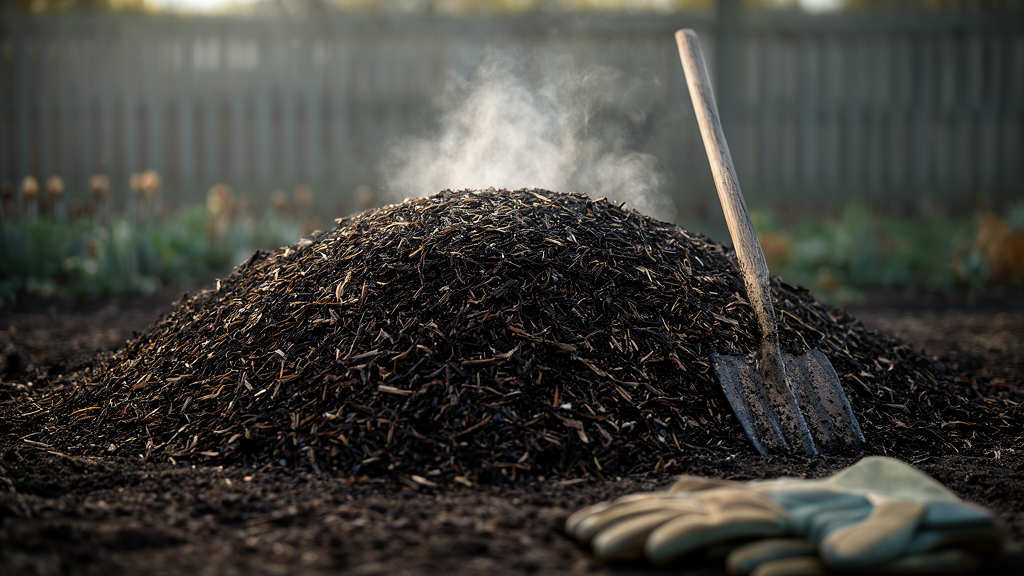
Here is the correct sequence: build your pile to 3x3x3 feet. Mix your greens and browns to a 30:1 C:N ratio by weight. Moisten it to the wrung-out-sponge level. Do not turn it. Wait. Let the pile sit for two to four weeks. If the pile is building correctly, the core temperature will rise to 131 to 160 degrees Fahrenheit within five to seven days. You will know it is working because the pile will feel warm to the touch, and you may see steam rising from the core on cold mornings.
Once the temperature peaks and begins to drop, turn the pile. This introduces oxygen, redistributes the microbes, and restarts the heating cycle. Repeat this process three to four times. The entire process takes eight to twelve weeks. If you turn it before the temperature peaks, you reset the clock. You are not speeding up the process. You are slowing it down.
When Hot Composting Is Not the Answer
Hot composting is not for everyone. It requires space, effort, and a willingness to manage a living system. If you have a small yard, a small pile, or a low tolerance for managing a pile, slow composting is the better choice. Slow composting takes six to twelve months, requires no turning, and produces excellent soil amendment. It does not kill weed seeds or pathogens, but it is easier, cheaper, and more forgiving.
Hot composting is for gardeners who want to produce compost quickly, who have the space to build a large pile, and who are willing to manage the process. If you fit that description, hot composting is worth the effort. If you do not, accept slow composting and stop trying to force heat into a pile that is physically incapable of holding it.
The Final Test: How to Know Your Compost Is Ready
Hot composting is not done when the pile looks like dirt. It is done when the pile has cooled, when the temperature has returned to ambient, and when the compost has stabilized. This usually takes eight to twelve weeks. The compost should be dark, crumbly, and smell like forest soil. If it smells like ammonia, it is too nitrogen-rich. If it smells like rotten eggs, it is too wet. If it smells like nothing, it is ready.
Sift your compost through a half-inch mesh screen. Remove any large, uncomposted pieces. Return them to your new pile. The fine, screened compost is ready to use. It will improve soil structure, increase water retention, and feed your plants. If you followed the steps above, you will have high-quality compost in eight to twelve weeks. If you did not, you will have a pile of rotting leaves that took six months to decompose. The choice is yours.