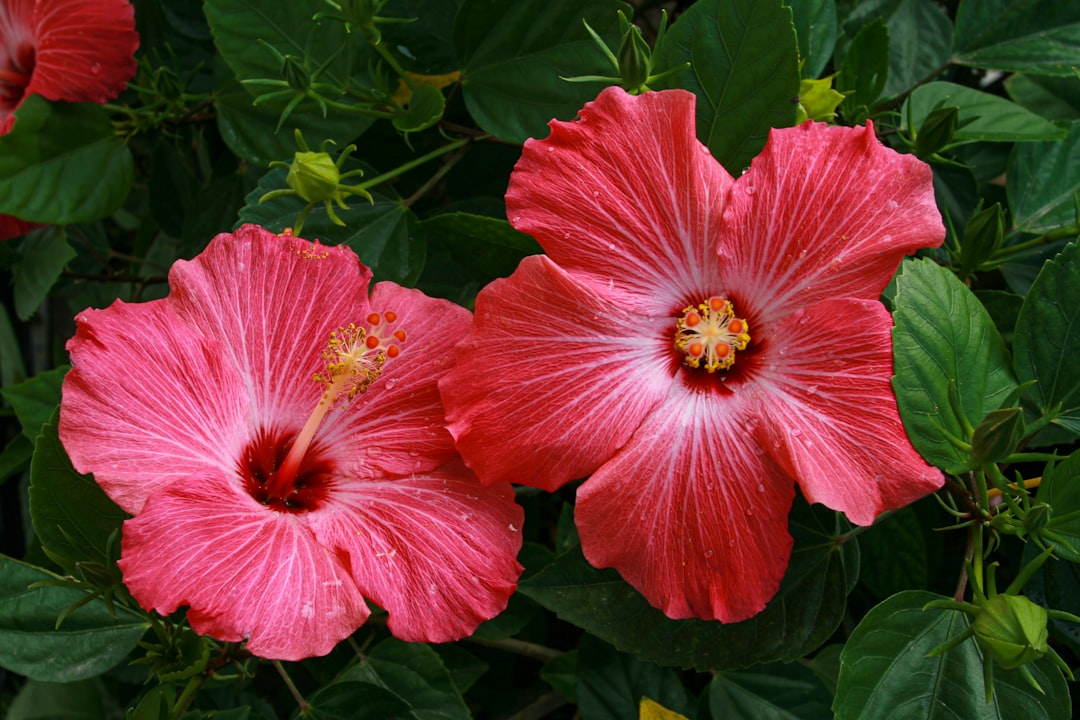
You are treating them like the same plant, and that is why your hardy hibiscus dies every winter. The visual similarity is deceptive. Both produce massive, show-stopping flowers in late summer, and both thrive in full sun with moist soil. But beneath the surface, they are structurally and biologically opposite. One is a true herbaceous perennial that survives winter by dying back to the ground. The other is a semi-woody shrub that must be protected from the cold. If you treat a hardy hibiscus like a rose of Sharon, you will mulch it too heavily and suffocate its crown. If you treat a rose of Sharon like a hardy hibiscus, you will cut it to the ground and watch your garden go bare for a full season. Understanding the stem wood difference is the single most important factor in keeping both alive.
Let’s look at the stems. This is not a botanical exercise; it is a survival manual. When you examine the base of a mature hardy hibiscus (Hibiscus moscheutos), you will find soft, green, herbaceous tissue. It is fleshy, it is full of water, and it is incredibly vulnerable to freezing temperatures. When the first hard frost hits in autumn, the stems turn brown, collapse, and die. The plant sends its energy down into a root system that looks like a thick, white ginger root. This root system is a storage organ, a true tuberous root, that holds enough energy to push up new, tall stalks the following spring. The plant does not survive the winter above ground. It survives below ground.
Now look at a rose of Sharon (Hibiscus syriacus). Run your hand up the stem. Past the soft green growth at the very tips, you will feel hard, woody bark. This is lignified tissue, the same structural wood found in trees and shrubs. The rose of Sharon does not die back to the ground. It retains its structural skeleton year after year. The new flowers bloom on the current season’s growth, but they branch off from last year’s woody framework. This fundamental difference in plant anatomy dictates every single cultural decision you make, from pruning to winter protection. Confusing the two is the most common mistake gardeners make in the perennial border.
Why the Herbaceous Stem Dictates Your Pruning Schedule
Because the hardy hibiscus stem is herbaceous, it has zero structural integrity once the frost arrives. This is not a flaw; it is an evolutionary strategy. By dying back, the plant avoids the physical damage that wind and ice inflict on rigid branches. It also avoids the energy expenditure required to maintain woody tissue through a long, cold winter. The plant invests everything into the root crown. This means your pruning strategy for hardy hibiscus is radically different from your strategy for rose of Sharon. You can and should cut the hardy hibiscus stems down to the soil level in late autumn, once they have completely turned brown. You do not need to leave any stubs. You are simply cleaning up dead matter to prevent fungal diseases from overwintering on the decaying tissue.
Contrast this with the rose of Sharon. Because it is a semi-woody shrub, it requires a completely different pruning approach. You must prune it in late winter or very early spring, before the new growth pushes through the woody branches. If you prune it in autumn, you risk exposing fresh, uncalloused cuts to freezing temperatures, which can split the woody stems and invite rot. Furthermore, because the rose of Sharon blooms on new wood that grows from last year’s branches, you must be careful not to cut off next year’s flower buds. This requires a light hand. You are shaping the shrub, not clearing dead matter. The woody stem protects the plant, but it also traps moisture and cold, making the pruning timing critical.
The confusion arises because both plants belong to the Malvaceae family, the mallow family. They share a love for moisture and sun, and they share a similar flower shape, large, funnel-shaped blooms with prominent stamens. But the Malvaceae family is incredibly diverse. It includes cotton, okra, and cacao, alongside these two garden staples. The family does not dictate a single growth habit. The hardy hibiscus represents the herbaceous end of the spectrum, while the rose of Sharon represents the woody shrub end. Recognizing this distinction stops you from applying one set of rules to both plants.
The Root Crown: Where Winter Survival Actually Happens
This brings us to the most critical part of the plant: the root crown. The root crown is the junction where the stem meets the roots. For the hardy hibiscus, this crown is the only part of the plant that must survive the winter. It is a thick, fleshy mass of storage tissue. Because it is herbaceous, it is highly susceptible to rot if it sits in waterlogged soil during the winter. This is why drainage is non-negotiable for hardy hibiscus. If your soil holds water, the root crown will freeze, rot, and die, regardless of how hardy the plant is supposed to be. You must plant your hardy hibiscus in well-draining soil, or amend heavy clay with plenty of organic matter and coarse sand to ensure water moves through the root zone quickly.
The rose of Sharon root crown is different. It is anchored by a network of woody, lignified roots that extend deep into the soil. These roots are more resilient to freezing than the fleshy crown of the hardy hibiscus, but they are still vulnerable to extreme cold, especially in USDA Zone 5. The woody root system does not rot as easily as the herbaceous crown, but it can still be damaged by freeze-thaw cycles. This is why mulching a rose of Sharon is different from mulching a hardy hibiscus. You want to keep the root zone consistently cold in winter to prevent premature thawing, which can trigger early growth that gets killed by subsequent freezes. A thick layer of mulch helps stabilize the temperature, but it must be applied correctly.
Here is the specific winter protection strategy for each. For the hardy hibiscus, after you cut the stems to the ground, you can pile a light layer of mulch over the root crown. This is not to insulate the plant against extreme cold, but to prevent heaving. Heaving occurs when the freeze-thaw cycle pushes the root crown up out of the soil, exposing it to the air and killing it. A few inches of shredded bark or straw is enough to keep the crown in place. Do not pile mulch high against the crown, as this can trap moisture and cause rot. The plant is hardy to Zone 4 or 5, depending on the cultivar, but it needs dry feet, not wet ones.
For the rose of Sharon, you do not cut the stems. You leave the woody structure intact. In Zone 5, you might apply a light layer of mulch around the base, but you must keep it away from the main woody stems to prevent rodent damage and rot. In Zone 4, you may need to wrap the shrub in burlap to protect the woody branches from desiccating winds. The woody branches can dry out in winter, especially if they are exposed to harsh, dry winds. The burlap acts as a windbreak, reducing moisture loss from the bark. This is a completely different set of concerns than the hardy hibiscus, which has no woody branches to dry out.
Soil and Water: The Shared Requirement That Masks the Difference
Both plants share a deep love for moisture and rich, fertile soil. This is where the confusion deepens. If you plant a hardy hibiscus in dry, sandy soil, it will struggle. If you plant a rose of Sharon in dry, sandy soil, it will also struggle. Both plants produce massive flowers that require significant water to support. The hardy hibiscus, with its large, herbaceous leaves, loses water rapidly through transpiration. It needs consistent moisture, especially during the summer blooming period. The rose of Sharon, with its woody structure, has a more established root system that can access deeper water, but it still performs best with regular watering during dry spells.
However, the way they use water is different. The hardy hibiscus relies on water pressure to keep its large, herbaceous stems upright. Without enough water, the stems wilt and collapse, even before the frost arrives. This is why hardy hibiscus often looks floppy in late summer if it has not received enough rain. The rose of Sharon, with its woody stems, does not wilt in the same way. It maintains its shape, even if the leaves droop slightly. This visual difference is another clue to the underlying structural difference.
Both plants benefit from a balanced, slow-release fertilizer in early spring. The hardy hibiscus will use this energy to push up tall, vigorous stems. The rose of Sharon will use it to produce new woody growth and flower buds. Do not over-fertilize either plant, as this can lead to excessive vegetative growth at the expense of flowers. Both plants prefer a soil pH between 6.0 and 7.0. They are not acid-loving plants, despite their tropical appearance. This shared preference for fertile, moist, neutral soil is what makes them easy to grow, but it also masks the fundamental differences in their winter survival strategies.
Choosing the Right Plant for Your Garden
So, which plant should you choose for your garden? The answer depends on what you value. If you want a dramatic, tropical-looking plant that dies back every winter and comes back with explosive growth in spring, choose the hardy hibiscus. It is perfect for the back of a perennial border, where its height (up to six feet) can be supported by the soil. It is also excellent for containers, where you can simply discard the old soil and start fresh each year. The hardy hibiscus is a low-maintenance plant once you understand its herbaceous nature. You cut it, you mulch it lightly, and you let it sleep. In spring, it wakes up and puts on a show.
If you want a woody shrub that provides structure to your garden year-round, choose the rose of Sharon. It is perfect for the middle of a border, where its semi-woody structure can be seen even in winter. It is also excellent for hedges, where its dense, woody growth can be shaped into a formal barrier. The rose of Sharon is a classic garden shrub, available in a wide range of colors and forms. It is more resilient to drought than the hardy hibiscus, once established, and it requires less frequent watering. However, it requires more attention in winter, especially in colder zones, where you may need to wrap it in burlap to protect the woody branches.
The stem wood difference is not just a botanical detail. It is the key to successful gardening. By understanding whether your plant is herbaceous or woody, you can make the right decisions about pruning, mulching, and winter protection. You can stop treating them like the same plant, and start treating them like the distinct, beautiful plants they are. The hardy hibiscus and the rose of Sharon are both magnificent additions to any garden. But they survive winter in completely different ways. Respect the stem, and your garden will thrive.
Sources & Further Reading
- Hibiscus moscheutos (Swamp Rose Mallow) — University of Minnesota Extension
- Hibiscus syriacus (Rose of Sharon) — Penn State Extension
- Hardy Hibiscus (Hibiscus moscheutos) — Royal Horticultural Society
Photo by Mick Haupt on Unsplash.