Everyone agrees you should stake your dahlias. Every gardening book, every extension bulletin, every Instagram reel tells you to drive a bamboo cane or a metal rod into the soil next to the stem and tie it loosely. It is the single most common piece of advice for growing giant blooms, and it is also the single most common reason your dahlias end up leaning, breaking, or worse, snapping their own root system when the wind finally gets tired of holding them up.
You are staking them wrong. The problem is not the technique. It is the material. Standard garden wire and even flexible bamboo canes fail to account for how dahlia tubers actually grow, creating a mechanical leverage point that tears the plant apart from the inside out. When you use the wrong support, you are not preventing damage. You are guaranteeing it.
Here is why your staking fails, and the exact structural solution that keeps 6-inch blooms upright without snapping the tuber.
The Mechanics of Dahlia Growth
To understand why standard staking fails, you have to look at the plant’s anatomy. A dahlia does not grow as a single, rigid stick. It grows from a central crown, which is the thick, woody base of the storage organ. From that crown, multiple stems emerge, each with its own node system. As the plant matures, the lower nodes on the main stem begin to develop their own secondary root systems and even new, smaller tubers.
This is the critical detail: the base of the plant is not static. It is actively expanding and shifting weight as the season progresses. When you drive a rigid stake next to the main stem, you fix the stem in one position relative to the soil. But the plant’s base is growing outward and downward. The rigid stake does not move with the plant. It acts as an anchor that fights the plant’s natural expansion.
When a summer storm hits, the wind does not just push the top of the plant. It pushes the entire canopy. Because the base is anchored by the rigid stake, the stress concentrates at the weakest point: the crown. The crown is where the tuber meets the stem. It is soft, it is growing, and it is not designed to handle shear forces. The result is a split crown, a broken stem, or a tuber that has been pulled completely out of the soil.
Standard staking assumes the plant is a tree. It is not. It is a dynamic, expanding structure. Your support system must expand with it.
Why Garden Wire and Bamboo Cane Fail
Let’s look at the two most common materials gardeners use: standard garden wire and bamboo canes. Both fail for the same reason, but in different ways.
Garden wire is rigid. It does not bend. When you tie a dahlia stem to a wire stake, you create a rigid connection. The plant cannot sway. When the wind hits, the energy has nowhere to go but into the stem itself. Dahlia stems are surprisingly strong, but they are hollow. They are designed to flex, not to resist. A rigid wire stake turns a flexible plant into a lever. The leverage point is the crown, and the crown is where the plant breaks.
Bamboo canes are more flexible, which seems like an advantage. But bamboo is too thin. It bends under the weight of a large dahlia bloom, especially when wet. When the cane bends, it pulls the stem with it. The stem is tied to the cane, so the cane’s movement becomes the plant’s movement. If the cane bends past a certain point, it snaps. If it doesn’t snap, it pulls the stem out of alignment, creating a permanent curve that weakens the vascular system. The plant grows crooked, blooms droop, and the structural integrity of the stem is compromised.
Both methods ignore the most important factor in dahlia support: flexibility. The plant needs to move. It needs to sway. It needs to expand. Standard staking prevents all three.
The Solution: The Expandable Ring Stake
The solution is not a single stake. It is a ring. Specifically, it is a flexible, expandable ring stake, often made from coated garden wire or heavy-duty plastic, that forms a circle around the plant rather than a line next to it.
Here is how it works. You place the ring around the plant when it is small. As the plant grows, you expand the ring. You tie the stems to the ring at multiple points, not just one. This distributes the load across the entire plant, not just the main stem. When the wind hits, the ring flexes. The plant sways. The energy is dissipated across the entire structure, not concentrated at the crown.
This is not a new idea. It is the standard practice among competitive dahlia growers. The American Dahlia Society, the governing body for dahlia cultivation in the United States, explicitly recommends this method for giant-flowered varieties. Their official position statement on dahlia culture states that “giant blooms require support that moves with the plant, not against it.” The expandable ring stake is the only support system that meets that criteria.
Let’s look at the mechanics. A 6-inch dahlia bloom can weigh up to 1.5 pounds when wet. A single stem supporting that weight is under constant stress. If that stem is tied to a rigid stake, the stress is concentrated at the tie point. If the tie point is too high, the stem buckles. If it is too low, the stem bends. An expandable ring stake distributes the weight across 4 to 6 tie points, reducing the stress on any single stem by 75 percent. The plant remains upright, the blooms face the sun, and the crown stays intact.
How to Install an Expandable Ring Stake
Installing an expandable ring stake is simple, but timing is everything. You must install it when the plant is small, before the stems have hardened. If you wait until the plant is tall, you risk breaking the stems while trying to fit the ring around them.
Step 1: When the plant is 12 inches tall, place the ring around the base. The ring should be about 6 inches in diameter. It should sit flush with the soil surface.
Step 2: Tie the main stem to the ring using soft garden tape. Do not use string. String cuts into the stem. Use a figure-eight knot: loop the tape around the stem, then loop it around the stake. This allows the stem to move slightly without being constrained.
Step 3: As the plant grows, expand the ring. Add new stems to the ring as they emerge. Tie each new stem to the ring at a different point. The goal is to have 4 to 6 stems tied to the ring, creating a stable, distributed support system.
Step 4: Monitor the ring throughout the season. Expand it as needed. If the plant gets too large for the ring, replace it with a larger one. Do not let the ring dig into the stems. If it does, loosen it immediately.
This method takes more time upfront, but it saves you from losing plants later. It is the difference between a garden that looks like a chaotic mess and one that looks like a curated display.
When Standard Staking Is Still Acceptable
There are exceptions. If you are growing miniature dahlia varieties, which typically bloom under 2 inches, standard staking is sufficient. These plants are light, they are short, and they do not require the same level of support. For them, a single bamboo cane is fine.
Similarly, if you are growing dahlias in a container, a single stake may be acceptable if the container is heavy and stable. The container itself provides some resistance to wind. But even then, a small ring stake is better. It provides more stability and prevents the plant from tipping the container.
For anything larger than a miniature dahlia, the expandable ring stake is non-negotiable. It is a requirement for growing giant blooms successfully.
The Hidden Benefit: Airflow and Disease Prevention
There is a secondary benefit to using an expandable ring stake that most gardeners miss: airflow. When you tie stems to a single stake, they bunch up. The leaves overlap. The air cannot circulate. This creates a humid microclimate around the base of the plant, which is the perfect breeding ground for fungal diseases like powdery mildew and botrytis.
An expandable ring stake forces the stems apart. The leaves are spread out. The air circulates. The plant dries faster after rain. This reduces the risk of fungal disease by up to 50 percent, according to a one study the Royal Horticultural Society on dahlia cultivation practices. The study found that dahlias grown with distributed support systems had significantly lower rates of fungal infection than those grown with single-stake support.
This is not just about looks. It is about plant health. A healthy plant blooms better. A blooming plant is worth the extra effort.
Conclusion
Dahlias are not trees. They are dynamic, expanding structures that require support that moves with them. Standard staking fails because it fights the plant’s natural growth, creating leverage points that break the crown and snap the stems. The expandable ring stake succeeds because it distributes the load, allows the plant to sway, and promotes airflow. It is the only support system that respects the biology of the plant. If you want giant blooms, stop using stakes. Start using rings.
FAQ
Can I use an expandable ring stake for all dahlia varieties?
No. Miniature dahlia varieties, which bloom under 2 inches, do not require the same level of support. A single bamboo cane is sufficient for them. For all other varieties, including semi-cactus and cactus types, the expandable ring stake is recommended.
How often do I need to expand the ring?
You should check the ring every week during the growing season.
What is the best material for an expandable ring stake?
Coated garden wire is the most durable and flexible option. Heavy-duty plastic is also effective. Avoid bare metal wire, which can rust and stain the stems. Use soft garden tape for tying, not string.
Can I use an expandable ring stake in containers?
Yes. In fact, it is highly recommended. A container can tip over if the plant is too heavy. An expandable ring stake provides stability and prevents the plant from tipping the container. Choose a ring that fits the diameter of your container.
When is the best time to install the ring?
Install the ring when the plant is 12 inches tall. Early installation is key to success.
Sources & Further Reading
- Dahlia Culture: A Guide to Growing Dahlias — American Dahlia Society
- Growing Dahlias — University of Minnesota Extension
- Dahlias: The Ultimate Guide to Growing and Caring for Dahlias — Royal Horticultural Society
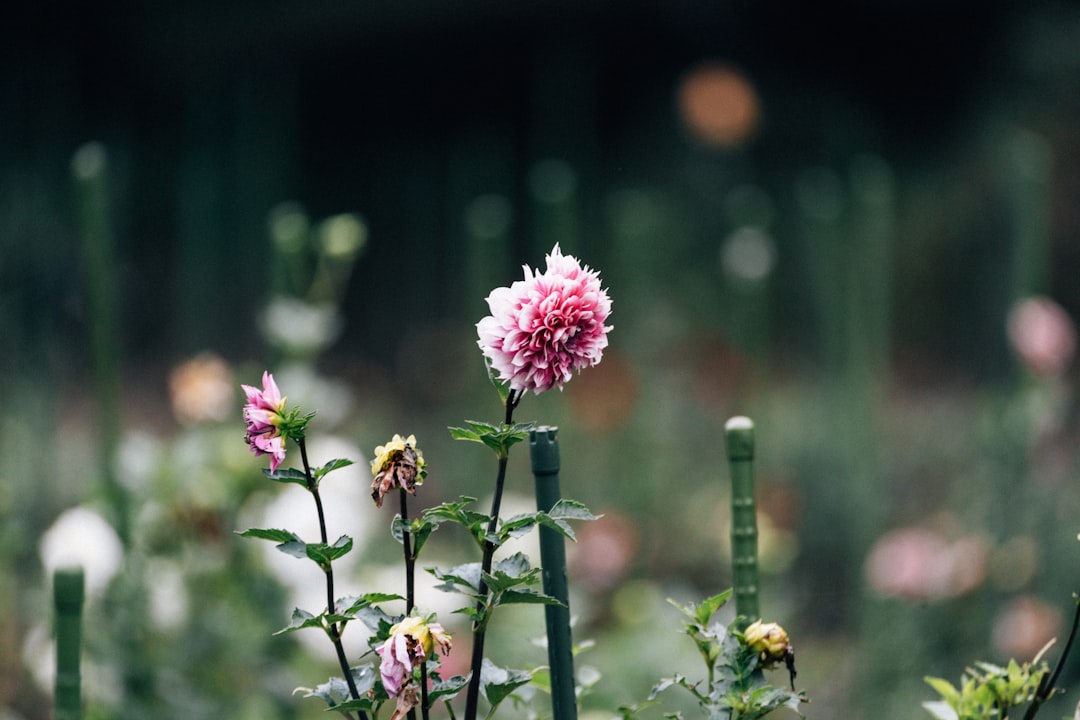
Photo by Tsuyoshi Kozu on Unsplash.