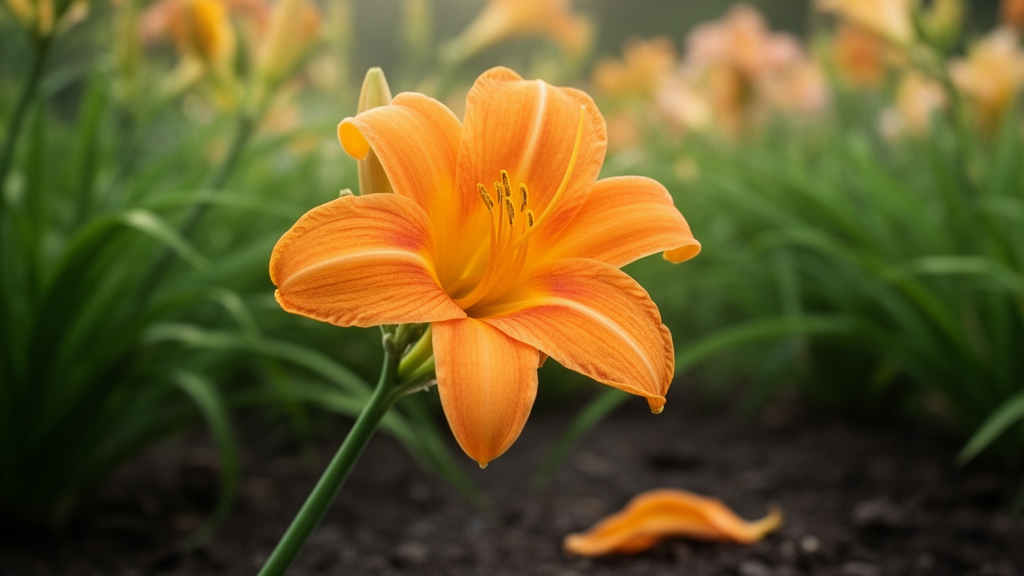
On a humid July afternoon in 2018, a gardener in central Ohio noticed something odd about her Hemerocallis fulva. She pruned a spent flower at 7:00 a.m. and walked past the same plant at 7:05 a.m. the next morning, finding a fresh bud opening on the same stalk. She counted the buds. She counted the hours. She calculated the exact number of flowers required to keep the border in bloom for a full month. The math was brutal, and it completely changed how she managed her garden.
Daylilies are not perennials that bloom for months. They are perennials that bloom for a single day, repeatedly. This is the fundamental misunderstanding that turns a lush, thriving daylily bed into a weed patch of green spikes and rotting stems. A single daylily flower lasts exactly 24 hours, sometimes 36 if the weather is cool and overcast. After that, the petals drop, the plant reabsorbs nutrients, and the flower is gone. If you want a month of continuous color, you do not plant one blooming variety. You plant the math.
The 24-Hour Constraint and the Bloom Window
Every daylily cultivar has a specific bloom window. Some bloom for exactly three days. Others, the ‘rebloomers’ or ‘remontant’ varieties, might bloom for three weeks. But within that window, every single flower operates on a strict 24-hour clock. This is not a suggestion from the plant. It is a biological imperative tied to pollination strategies in the wild. In nature, the flower opens, attracts pollinators, sheds its pollen, and collapses to conserve energy for the next bud on the same stem. The plant does not care about your garden aesthetic. It cares about resource allocation.
When you plant a single daylily variety, you are betting on a narrow window of color. If you plant 20 different cultivars, you are betting on a staggered window. But the real secret to a month-long bloom is understanding the scape architecture. A single daylily plant produces multiple flower buds along a single stalk, called a scape. A robust, mature plant might produce 40 to 60 buds on one scape. If each bud opens one per day, that single plant will bloom for 40 to 60 days. This is why experienced gardeners do not count plants; they count buds per plant, and they count the number of plants required to cover the calendar.
Why Deadheading Is Not Enough
Most gardeners deadhead daylilies. They pinch off the spent flower to keep the bed looking tidy. This is a well-intentioned mistake. Deadheading does not stop the plant from blooming; it just stops the flower from dropping its petals. The plant still expends energy to open the bud, pollinate (if insects are present), and then reabsorb the nutrients. The flower still lasts 24 hours. The only thing deadheading changes is the visual clutter. It does not extend the bloom window. It does not increase the number of flowers. It just makes the garden look cleaner while the plant does the exact same amount of work.
The real goal is to manage the scape. Once a scape has finished blooming, the plant stops producing new buds on that specific stalk. The stem turns yellow, then brown, and the plant redirects all remaining energy to the root system for winter storage. If you leave the spent scape on the plant, it looks messy, but it does not harm the plant. If you cut the scape down to the base, you remove the visual clutter, but you also remove the plant’s ability to photosynthesize through that stem. The stem is not just a flower holder; it is a leaf. It feeds the roots. Cutting it too early starves the plant for next year.
The Math of Continuous Color
Let’s do the math. You want your border to bloom continuously for 30 days. You have 10 daylily plants. Each plant produces 50 buds per season. That is 500 total flowers. If each flower lasts 24 hours, you have 500 flower-hours of color. To cover 30 days, you need 30 flowers open at any given time (one per day, multiplied by 30 days). 500 flowers divided by 30 days equals 16.6 plants. You need 17 plants to cover 30 days, assuming every flower opens and no buds abort.
But buds abort. Inconsistent watering, nutrient deficiency, or extreme heat will cause the plant to drop buds before they open. This is called ‘bud blast.’ If 20% of your buds blast, your 500 flowers drop to 400. Your 30-day window shrinks to 24 days. This is why you never plant the minimum number of plants. You plant 1.5 times the calculated number to account for bud blast, weather extremes, and cultivar variability.
Choosing the Right Cultivars for the Math
Not all daylilies are created equal. Some bloom early in the season, some bloom mid-season, and some bloom late. To achieve continuous color, you must plant a sequence. You need early-bloomers, mid-bloomers, and late-bloomers. You need short-bloom-window cultivars (3-5 days) and long-bloom-window cultivars (3-4 weeks). You need ‘rebloomers’ that push a second flush of flowers after the main bloom cycle ends.
Early bloomers (June): ‘Stella de Oro’ is the classic rebloomer. It blooms for 60-90 days, but its individual flowers still last 24 hours. It is a workhorse. ‘Pardon Me’ blooms for 3-4 days, but it blooms early. ‘Happy Returns’ is another rebloomer, slightly shorter than ‘Stella de Oro’.
Mid-season bloomers (July): ‘Burgundy Lace’ blooms for 3-4 days. ‘Fire and Ice’ blooms for 3-4 days. ‘Hyperion’ blooms for 4-5 days. These are the backbone of the border. They provide the bulk of the color.
Late bloomers (August-September): ‘Babbling Brook’ blooms for 3-4 days. ‘June’s Dark Angel’ blooms for 3-4 days. ‘Kathleen Rita Duncan’ blooms for 3-4 days. These extend the season into early fall, before the first frost kills the foliage.
By mixing these categories, you ensure that as one cultivar finishes its 3-5 day window, another is just opening its first bud. The overlap is what creates the illusion of continuous bloom. The math is simple: you are not planting flowers. You are planting time.
When the Math Breaks Down
The math assumes perfect conditions. It assumes no bud blast, no pest damage, and no extreme weather. In reality, bud blast is common. High temperatures above 90°F (32°C) will cause buds to abort. Drought stress will cause buds to abort. Over-fertilizing with nitrogen will cause the plant to produce foliage at the expense of flowers. This is why you must fertilize lightly in early spring, and stop fertilizing by mid-June. Let the plant focus on blooming, not growing leaves.
Pests are another factor. Daylily rust, thrips, and spider mites can damage buds before they open. Thrips are the silent killers. They get inside the bud, feed on the developing petals, and the bud turns brown and drops. You will never see them. You will just see a missing flower. This is why you must monitor your plants closely in early summer. Spray with a neem oil solution if you see thrips. It is the only way to protect the buds.
The Payoff
Daylilies are the ultimate garden math problem. They are simple, resilient, and brutally honest. If you plant them correctly, they will bloom for months. If you plant them incorrectly, they will bloom for a week and then go to sleep. The secret is not in the plant. It is in the math. Count the buds. Count the days. Count the plants. And then plant 1.5 times that number. The rest is just waiting for the 24-hour clock to tick.