You are killing your perennials by giving them too much water. Not too little. Too much. The single most common reason a new garden center purchase dies within twelve months is that you treat it like a container annual, watering it every time the top inch of soil feels dry, and drowning a plant that evolved to survive drought by storing water in a deep root system.
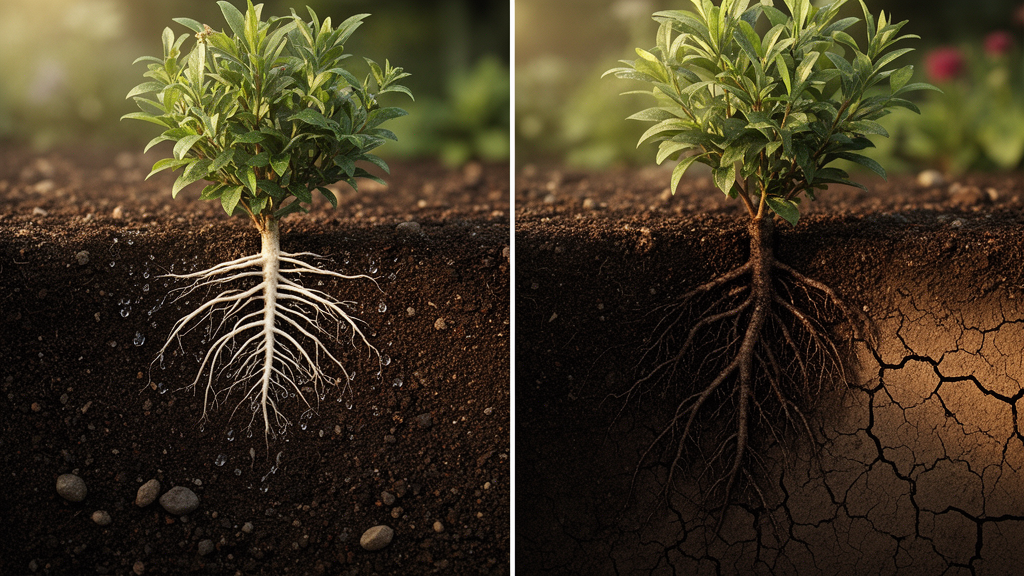
That first-year death is not a mystery. It is a predictable consequence of applying annual logic to a perennial root architecture. Annuals have shallow, fibrous root systems that dry out fast and need frequent water. Perennials invest their first season building a root crown and a taproot or rhizome system that reaches down three, four, or sometimes six feet into the soil profile. When you water them like annuals, you train those roots to stay shallow, and the next dry spell kills them because they never learned to go deep.
The Root Architecture Mismatch
Most perennials sold at garden centers arrive in 4-inch pots with root systems that look like a dense mat of white fibers. That is not a perennial root system. That is a container root system. The plant has been forced to grow in a confined space, and its roots have wrapped around the bottom of the pot in a tight spiral. When you plant it in the ground and water it weekly, those roots never break out of that spiral. They stay shallow. They stay weak. They die when the weather turns.
A healthy perennial root system looks nothing like a pot-bound mat. It looks like a tree. The crown sits at or just below the soil line. From that crown, thick storage roots or rhizomes spread outward and downward. A mature peony root system can reach six feet deep. A mature echinacea root system anchors itself two to three feet down. A mature salvia root system spreads wide and deep, finding moisture even in dry summer soil.
When you water a newly planted perennial every three days, you are telling those roots: “Stay here. Stay shallow. Stay safe.” They obey. They grow exactly where you water them. And when summer heat hits and the top two inches of soil dry out, the plant has no deep roots to fall back on. It wilts. It dies. You blame yourself. You blame the soil. You blame the weather. The truth is simpler: you watered it like an annual.
The Three-Week Rule
Here is the exact schedule that fixes the problem. For the first three weeks after planting a perennial, water it deeply once a week. Not every three days. Not every other day. Once a week. Deeply. That means enough water to soak the soil to a depth of six inches. Use a screwdriver test: push a long screwdriver into the soil near the plant. If it goes in easily to the full length, the water reached deep. If it stops at the top inch, you did not water deeply enough.
After three weeks, stop watering on a schedule entirely. Water only when the soil is dry at a depth of four inches. Stick your finger or a soil probe into the ground. If it comes out dry, water. If it comes out damp, wait. This forces the roots to grow downward in search of moisture. They will. They always do, given the chance.
By the end of the first growing season, your perennial will have developed a root system that looks like a real perennial root system: deep, wide, and self-sufficient. It will survive drought. It will survive winter. It will bloom the following year without your intervention.
What This Breaks Down
This watering schedule does not work for every plant. It breaks down in three specific cases, and knowing them saves you from wasting time on plants that simply do not respond to drought training.
Case one: bog plants. If you planted a cardinal flower, a Joe Pye weed, or a marsh marigold, the three-week rule will kill them. These plants evolved in wet soil and shallow water. They need constant moisture. Water them like bog plants, not like drought-tolerant perennials. The rule does not apply.
Case two: container-grown perennials with severely root-bound root systems. If you bought a perennial that has been in a pot for two or more years, the roots may have formed a solid root ball that water cannot penetrate. Before you plant it, you must break that root ball. Use a knife or your fingers to tear the outer inch of roots. If you do not, water will run straight down the sides of the root ball and never reach the center. The plant will dry out from the inside, even if you water it daily. This is not a watering problem. It is a planting problem.
Case three: clay soil without amendment. If your soil is heavy clay and you did not amend it before planting, water will sit on top of the soil for hours and then slowly soak in. The roots will sit in standing water. They will rot. No watering schedule fixes clay soil that has not been amended. You must dig out a planting hole twice as wide as the root ball and mix in compost or aged manure. Then water as described above. Without amendment, clay soil kills perennials regardless of how you water them.
Why This Matters Beyond One Plant
Getting this wrong costs you money. You buy a plant for $12. It dies in six weeks. You buy another one. It dies. You spend $36 on three plants that should have cost $12. That is the direct cost.
The indirect cost is higher. It is the confidence you lose. You start to believe you have a black thumb. You stop buying perennials. You fall back on annuals because they are forgiving. You fill your garden with petunias and marigolds and never discover what a garden actually looks like when it is allowed to mature. That is a cost you cannot put a dollar sign on.
When you water perennials correctly, you are not just saving one plant. You are building a garden that gets easier every year. The first year, you learn the schedule. The second year, the plants bloom without your intervention. The third year, they divide themselves and you have free plants. The fifth year, you have a garden that looks like it has been there for decades. That is the payoff. It takes one season of discipline to earn it.
The Test You Can Run Tonight
Go outside. Find the most recent perennial you planted. Stick your finger into the soil next to it. If it is damp at four inches, stop watering it. If it is dry, water it deeply once. Then wait. Check it again in seven days. If the soil is still dry at four inches, water it again. If it is damp, wait another seven days. Do this for the next three weeks. Then switch to the four-inch check and stop watering on a schedule entirely.
Watch what happens. The plant will not die. It will root. It will bloom. It will survive. And next spring, when your neighbors are buying replacement plants, yours will be the one that is already established, already blooming, already doing the work without you.