
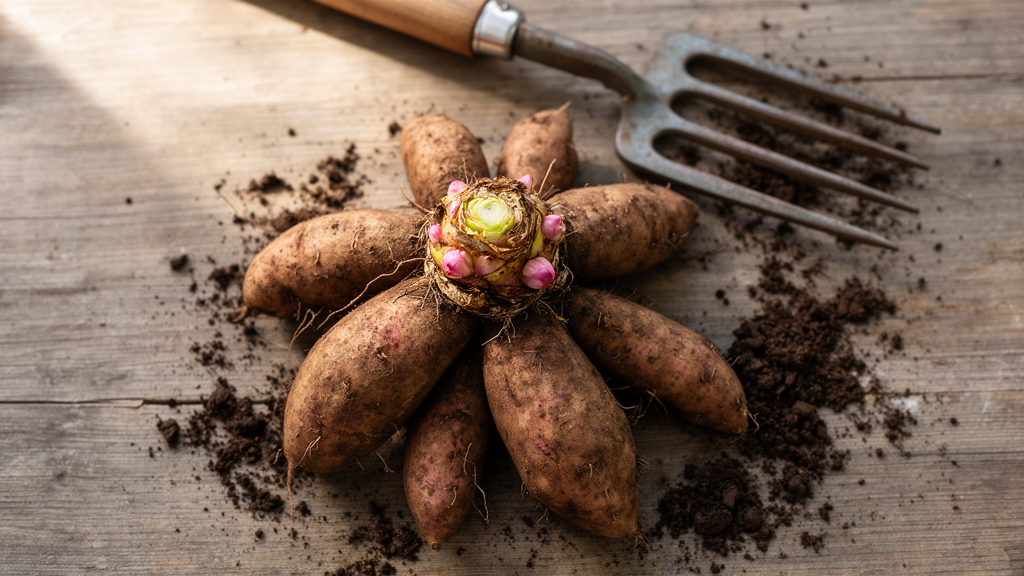
Dahlias grow from tubers. That single fact changes how you plant, store, and divide them, and most gardeners get it wrong because they call them corms. The distinction is not botanical pedantry. It is the difference between a plant that survives your winter and one that rots in the ground. A corm is a solid, swollen stem base. A tuber is a swollen root tip. They store energy in completely different tissues, and they fail in completely different ways when you treat them as interchangeable.
Dahlia tubers are not the same as potato tubers either. A potato tuber is a swollen underground stem (a stolon tip). A dahlia tuber is a swollen root tip. They look similar enough to confuse anyone who has never held one in their hands, but their anatomy dictates how they respond to cold, to division, and to rot. When you understand which storage organ you are handling, you stop guessing and start making decisions based on actual plant biology.
Here is what most gardeners do wrong, and how to fix it before the first frost.
The Anatomy Nobody Explains (And Why It Matters)
When you buy a dahlia from a nursery in spring, you are buying a cluster of thick, brown, finger-like structures attached to a small, central crown. Those structures are tubers. They are not stems. They are not corms. They are modified roots that store carbohydrates and water for the next growing season.
A corm, by contrast, is a solid, vertical stem base. Crocus, gladiolus, and freesia grow from true corms. The corm is layered like an onion, but those layers are not scales. They are compressed stem tissue. If you cut a corm in half, you see concentric rings. If you cut a dahlia tuber in half, you see a solid, starchy interior with no rings.
Why does this matter? Because corms and tubers fail differently when exposed to cold. A corm can tolerate a harder freeze if it is dry. A dahlia tuber will rot if it sits in wet soil at 40 degrees Fahrenheit. A corm can be divided by cutting through the stem base. A dahlia tuber must be divided so that each piece retains a portion of the crown, the central stem tissue from which new shoots emerge. Without that crown, the tuber is just a potato with no eyes. It will not grow.
The Royal Horticultural Society’s dahlia growing guide (2023) states this clearly: “Each division must contain at least one eye or growth point attached to the crown.” Most gardeners ignore that sentence. They cut the tuber cluster into arbitrary pieces, toss them in a box, and wonder why half of them never sprout. The failure is not bad luck. It is bad anatomy.
How to Divide Dahlias Without Killing Them
Division is the single most common way gardeners kill their dahlias. Not because the plant is fragile. Because they do not understand what they are dividing.
Here is the correct process, step by step:
- Wait until after the first hard frost. The foliage should be blackened and dead. This signals the plant has pulled all available carbohydrates back into the tubers. If you dig them up before the frost, you are robbing the tubers of the energy they need to survive winter.
- Gently lift the entire tuber cluster from the ground. Use a garden fork, not a shovel. A shovel will slice through tubers. A fork lets you pry the soil loose around the edges. Work from the outside in. Do not yank the dead stem. Pulling the stem can tear the crown from the tubers, and once the crown is gone, the tubers are dead weight.
- Brush off excess soil. Do not wash them. Washing introduces moisture that encourages rot during storage. Use a soft brush or your hands to remove loose dirt. If soil is packed tightly between tubers, use a knife to gently separate them. Do not force separation. If a tuber resists, leave it attached. It is safer to store a larger cluster and divide it in spring than to force a clean split and damage the crown.
- Inspect the crown. The crown is the small, woody structure at the center where the stem meets the tubers. It should be firm, not mushy. If the crown is soft or smells like rot, cut it away with a clean knife. Discard any tubers attached to the rotten crown. Healthy tubers will be firm to the touch, with a leathery skin and no soft spots.
- Divide the cluster so each piece has at least one eye. An eye is a small, pink or purple bump on the crown. This is where the new shoot emerges. Use a sharp, clean knife to cut between tubers. Do not cut through a tuber. If a tuber cluster is large, you may need to cut through the crown itself. That is fine, as long as each resulting piece retains at least one eye. If you are unsure, leave the cluster intact and divide it in spring. It is better to have fewer plants that grow than many tubers that rot.
- Let the cut surfaces callus. Place the divided tubers in a single layer in a cool, dry, well-ventilated space. A garage, basement, or shed works. Do not stack them. Do not wrap them in plastic. Let the cut surfaces dry for 24 to 48 hours. This forms a protective layer that prevents rot during storage.
- Store them in a cool, dry place at 40 to 45 degrees Fahrenheit. Use peat moss, vermiculite, or wood shavings to cushion the tubers. Do not use plastic bags. Do not use newspaper directly against the skin. Place the tubers in a cardboard box or paper bag with ventilation holes. Label each variety. You will forget which is which by February.
That is it. No hormones. No special soil. No magic. Just anatomy, timing, and patience.
Why Your Dahlias Rot in the Ground (And How to Stop It)
If you live in a climate where winter temperatures drop below 20 degrees Fahrenheit, you must dig up your dahlias before the first hard freeze. They are not cold-hardy. They will rot in the ground. Period.
But here is the part most gardeners miss: dahlias rot in the ground not because they are cold-sensitive. They rot because they are wet-sensitive. A dahlia tuber sitting in wet soil at 40 degrees will rot in two weeks. A dahlia tuber sitting in dry soil at 40 degrees will survive for months. Moisture is the enemy. Cold is secondary.
If you choose to leave your dahlias in the ground (only recommended for USDA zones 7 and warmer, and even then with heavy mulch), you must ensure the soil drains exceptionally well. Add compost and coarse sand to heavy clay soils before planting. Do not plant dahlias in low spots where water collects. Do not overwater them in late summer. Let the soil dry out between waterings. A dahlia tuber that stays dry through autumn will survive a mild winter. A dahlia tuber that sits in wet soil will rot before the first frost even arrives.
The University of California Agriculture and Natural Resources extension service published a dahlia growing guide in 2021 that emphasizes this point: “Dahlias are susceptible to root rot in poorly drained soils. Ensure planting sites have excellent drainage, and avoid overhead watering.” This is not optional advice. It is the difference between a plant that survives and one that does not.
When to Plant Dahlias in Spring (And When Not To)
Most gardeners plant dahlias too early. They pull them out of storage in March, slap them in the ground, and wonder why they rot. Dahlias are warm-season plants. They need soil temperatures of at least 60 degrees Fahrenheit to sprout. Plant them before the soil warms, and you are planting a tuber in cold, wet soil. It will rot. There is no way around it.
Here is how to time it correctly:
- Wait until after the last frost date in your area. This varies by zone, but the rule is universal: do not plant until the soil has warmed to 60 degrees. Use a soil thermometer. Do not guess based on the calendar.
- Chit your tubers indoors if you have a short growing season. Place the tubers in a shallow tray with moist peat moss or vermiculite. Keep them in a bright, warm spot (65 to 70 degrees). Wait until you see 1 to 2 inches of green shoots emerging from the eyes. This gives you a head start of 3 to 4 weeks. Do not plant them until the shoots are established. A long, leggy shoot will break if you plant it too early.
- Plant the tubers 4 to 6 inches deep. Bury the crown 2 to 3 inches below the soil surface. Bury the tubers 2 to 3 inches deeper. This protects them from drying out and provides stability for tall varieties.
- Water them in thoroughly, then let the soil dry out. Dahlias do not like wet feet. Water deeply once a week, but let the top 2 inches of soil dry between waterings. Overwatering is the second most common way gardeners kill their dahlias, right after planting too early.
That is the entire planting process. No fertilizer at planting. No bone meal. No miracle-gro. Dahlias are heavy feeders, but they do not need fertilizer at planting. They need compost worked into the soil before planting, and a balanced fertilizer applied once the shoots are 6 inches tall. Fertilizing at planting burns the tubers and delays sprouting.
FAQ
Can I plant dahlia tubers directly in the ground, or should I start them indoors?
You can plant them directly in the ground after the last frost, but starting them indoors gives you a 3 to 4 week head start. Chit them in a tray with moist peat moss until shoots emerge, then transplant carefully. Do not let the shoots grow longer than 2 inches before planting.
Why do my dahlia tubers rot during storage?
Rot during storage is almost always caused by moisture. Store tubers in a dry, well-ventilated space at 40 to 45 degrees. Use peat moss or vermiculite to cushion them, but do not let the medium stay wet. Check them monthly for soft spots. Discard any tubers that feel soft or smell like rot.
How often should I water dahlias once they are growing?
Water dahlias deeply once a week, but let the top 2 inches of soil dry between waterings. They do not like wet feet. Overwatering causes root rot, which is the second most common cause of dahlia death. If the soil stays damp for more than 48 hours after watering, reduce your watering frequency.
Can I leave dahlia tubers in the ground over winter?
Only if you live in USDA zones 7 or warmer, and even then, only with heavy mulch. Dahlias are not cold-hardy. In zones 6 and colder, you must dig them up before the first hard freeze. Leave them in the ground in warmer zones, but ensure the soil drains exceptionally well. Wet soil at 40 degrees will rot them in two weeks.
What is the difference between a dahlia tuber and a potato tuber?
A dahlia tuber is a swollen root tip. A potato tuber is a swollen underground stem (a stolon tip). They store energy in different tissues and fail in different ways when exposed to cold. A dahlia tuber will rot if it sits in wet soil at 40 degrees. A potato tuber can survive a harder freeze if it is dry. Do not treat them the same way.